The LDO (Low dropout) regulator is a linear voltage regulator with a small I/O differential voltage. These voltage regulators offer a wide input voltage range, quick transient response, low noise with high PSRR & low quiescent current. A linear voltage regulator is a power supply IC that outputs a stable voltage, used in different electronic devices. So these regulators control heat build-up and allow efficient utilization of energy. LDO regulators are available from other manufacturers like; L4940V5 IC, TPS7A57, TPS7A94, TPS7A39, etc. Thus, this article provides an overview of the L4940V5 IC, pinout, specifications, and its applications.
What is L4940V5 IC?
The L4940V5 is a three-pin, fixed output positive low dropout linear voltage regulator with 450mV low dropout voltage at 1A load and is available in the T0-220 package. So this voltage regulator is mainly suitable for battery-powered equipment to decrease prolonged battery life and consumption. This voltage regulator is available in different voltage ranges, thus utilized in different voltage applications. In addition, it can also be used in battery systems to increase the operating life of the battery. So this IC has anti anti-saturation circuit, internal current limiting, safe area protection, and thermal shutdown.
L4940V5 IC Working
The L4940V5 low dropout voltage regulator IC works by contrasting the output voltage with a reference voltage and also adjusting the pass device to maintain a stable output voltage. This IC is perfect for battery-powered equipment due to its minimum I/O voltage drop that decreases consumption and also extends battery life. So this IC has a secure area shield, inside current limiting, thermal shutdown, fast transient response, and anti-saturation circuit.
L4940V5 IC Pin Configuration:
The pin configuration of the L4940V5 IC is shown below. This IC includes three pins which are discussed below.
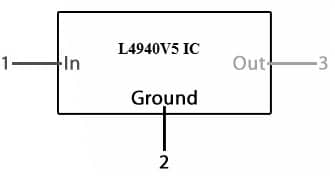
L4940V5 IC Pin Configuration
- Pin-1 (Input): It is an input supply pin of the voltage regulator IC.
- Pin-2 (Ground): It is a GND reference of IC.
- Pin-3 (Output): It is a 5Volts output pin of regulator IC.
Features & Specifications:
The features and specifications of L4940V5 IC include the following.
- L4940V5 IC is a three-terminal LDO voltage regulator.
- This voltage regulator IC includes three pins.
- The mount is a through-hole.
- It is available in the TO-220-3 package.
- The packaging type is Tube.
- It has very low quiescent current, short-circuit protection, thermal shutdown & reverse polarity protection.
- The low dropout voltage is 450mV.
- Peak o/p current at 2V is 2.25A.
- Its quiescent current is 5mA
- It has precise outputs like; 5V, 8.5V, and 12 V
- The terminal finish is matte tin.
- Its maximum current supply is 50mA.
- Maximum input voltage is 17V.
- Its output type is fixed.
- It has a positive output configuration.
- Output voltage is 5Volts.
- Maximum voltage dropout at 1.5A is 0.9V.
- Dropout voltage is 500mV.
- The minimum output voltage is 4.9V
- Its nominal o/p voltage is 5V.
- Operating temperature ranges from -40°C to 150°C.
- Moisture Sensitivity Level or MSL is 1 (Unlimited).
- Its quiescent current is 8mA
- PSRR is 68dB (120Hz).
- Its maximum voltage tolerance is 4%.
Equivalent & Alternatives
Equivalent L4940V5 IC is AMS1117-5 and alternative L4940V5 ICs are; 78L05, LM7805, LM317, etc.
L4940V5 LDO Regulator Circuit Diagram
The 5V L4940V5 LDO voltage regulator circuit is shown below. Generally, voltage regulators need the input voltage to be a minimum of a few higher volts as compared to the output voltage for correct regulation because the output mainly depends on an NPN stage.
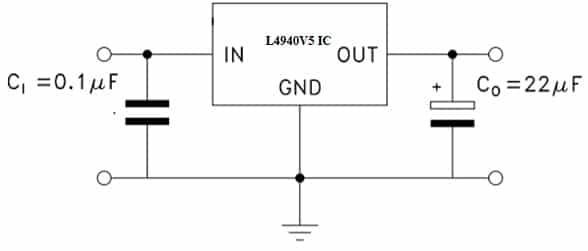
L4940V5 LDO Regulator Circuit
Similarly, the output stage for a low-dropout regulator is PNP-based which means, the VBE drop can be observed from the i/p to the o/p, so huge lower dropout voltages can be attained. So that the voltage regulator can be operated even if the input voltage is higher than the input voltage. This is mainly helpful for battery-powered devices.
It is significant to note that LDO regulators can be unstable, thus output decoupling can be done with correct precaution. So, these regulators can oscillate if there is decoupling or no decoupling with too small internal resistance.
L4940V5 vs LD2979Z50TR
The difference between L4940V5 and LD2979Z50TR includes the following.
|
L4940V5 |
LD2979Z50TR |
| L4940V5 is a low dropout voltage regulator. | LD2979Z50TR is a very low-drop voltage regulator. |
| It is available in TO-220 & D2PAK packages. | It is available in the TO-92 package. |
| The maximum dropout voltage is 0.9 V. | Its maximum dropout voltage is 0.6 V. |
| Dropout voltage minimum is 0.5 V. | The minimum dropout voltage is 0.2 V. |
| The absolute maximum input voltage is 30 V. | Its absolute maximum input voltage is 16 V. |
| Its input voltage range is from 6 Volts to 17 Volts. | Input voltage max is 6 Volts to 16 Volts. |
| Max line regulation is 0.01% | Maximum line regulation is 0.032% |
| Its operating temperature ranges from -40 °C to 150 °C. | Operating temperature ranges from -25 °C to 125 °C. |
| The maximum output current is 1.5 A. | The output current maximum is 0.05 A. |
| Its package shape is rectangular. | The package shape of this regulator is round. |
Please refer to this link for Voltage Regulators MCQs.
Please refer to this link for the L4940V5 IC Datasheet.
Advantages & Disadvantages
The advantages of L4940V5 IC include the following.
- L4940V5 IC provides a broad range of incorporated security and safety features like; short-circuit protection, overload protection, over-temperature protection and reverse polarity protection.
- They can generate low noise & low consumption because of their low quiescent current.
- They can adapt quickly to changes within load conditions, which is significant within dynamic electronic systems.
- They can help ensure steady and secure operation at a stable voltage.
- They maintain the voltage supply over a broad input voltage range.
- L4940V5 voltage regulators protect a system from battery reversal whenever interfacing with a battery.
- These are compact and more reliable as compared to switching regulators.
- They have a thermal shutdown, short-circuit protection, very less quiescent current, reverse polarity protection, etc.
The disadvantages of L4940V5 IC include the following.
- L4940V5 ICs are affected by bipolar shot noise, flicker noise & thermal noise.
- These regulators have stability issues because of feedback circuits, the possible load range & the changeability of elements in the loop.
- These voltage regulators are more complex and costly.
- These regulators have slower transient response and low efficiency.
- LDOs can be unstable, thus output decoupling has to be included carefully.
Applications
The uses of L4940V5 IC include the following.
- L4940V5 voltage regulators are suitable mainly for battery-powered equipment due to their low I/O voltage drop to reduce power consumption & improve battery life.
- This voltage regulator is utilized in automotive, consumer, and industrial applications.
- This IC can be utilized with different types of sensors like; air quality sensors, accelerometers, ambient light sensors, etc.
- These voltage regulators are ideal for MCUs, FPGAs & DSPs due to their fast transient response & ultralow dropout.
- It is used for on-card regulation, linear o/p stage for SMPS, and battery-operated electronic devices.
Thus, this is an overview of the L4940V5 IC, pin configuration, features, specifications, circuit, working, pros, cons, and its uses. The L4940V5 IC is a three-pin LDO regulator, available in both TO-220 & D2PAK packages with several fixed output voltages, used in different consumer and industrial applications. Here is a question for you, what is LM7805 IC?