TRIAC is a three-terminal and bidirectional AC switch that allows the flow of electrons in any direction, but its flow can change based on the voltage gate direction. The applied AC can calculate this voltage at the load connections of the TRIAC. It is equivalent to two SCRs which are connected in a reverse parallel or a back-to-back arrangement. These devices are available in different packaging arrangements, and they handle an extensive range of voltage & current. TRIACs are versatile due to their capability to operate with positive or negative voltages across the terminals. These are used in switching designs, phase control, chopper designs, speed control in fans, motors, lighting control, etc. This article discusses an overview of the BTA12 TRIAC, pinout, specifications, and its applications.
What is BTA12 TRIAC?
The BTA12 TRIAC is a medium-power semiconductor device with a low holding current, a high surge energy, and outstanding pulsed energy dissipation. These TRIACs are suitable for applications like LED dimmers & motor controllers. BTA12 TRIAC handles inductive loads without a snubber, which is achievable due to the thermal mass.
These TRIACs are available either in surface-mount or through-hole packages. The BTA12, T12xx & BTB12 Triac series are appropriate for general-purpose mains power AC switching. These are also suggested for phase control operations within light dimmers & appliance motor speed controllers.
The Snubberless versions are particularly recommended for utilization on inductive loads because of their high commutation performance. These versions with internal ceramic pads provide an insulated tab complying with UL standards. Logic Level BTA12-600SW & BTA12-600TW provide low holding current, which is perfect for designing light dimmers, mainly for LED lamps.
The BTA12 Triac is appropriate for general-purpose mains power AC switching. These can be utilized in applications like; heating regulation, induction motor starting circuits & static relays as an ON/OFF function. These are also suggested for phase control operations within speed controllers & light dimmers for appliance motors.
BTA12 TRIAC Pin Configuration:
The pin configuration of the BTA12 TRIAC with its symbol is shown below. This TRIAC includes three pins, and each pin’s functionality is discussed below.
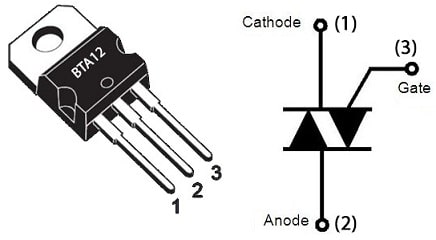
BTA12 TRIAC Pin Configuration
- Pin1 (A1): Current supplies in/out of this ‘A1’ terminal.
- Pin2 (A2): Current supplies in/out of this ‘A2’ terminal.
- Pin3 (G): Current controls conduction into/out of this terminal between A1 & A2.
Features & Specifications:
The features and specifications of BTA12 TRIAC include the following.
- BTA12 is a medium-current TRIAC.
- This TRIAC includes three pins with the TO220 package.
- Its operating temperature ranges from -40°C to 125°C TJ.
- The mount type is Through Hole.
- The packaging type is Tube
- DC Voltage Rated is 700V
- Repetitive Reverse Voltage or Vrrm Maximum is 700V
- Its holding current is 50mA.
- Its maximum voltage to gate trigger or Vgt is 1.3V.
- Its maximum current – gate Trigger or Igt is 50mA.
- Its maximum On-State voltage is 1.5V.
- The minimum critical speed of increase of Off-State voltage is 100V/us
- The type of trigger device is TRIAC.
- Its maximum leakage current is 0.5 mA.
- It is appropriate for general-purpose AC switching.
- It has low-thermal resistance bonding.
- It is a medium-power TRIAC – 600V @ 12A.
- It has a high surge energy capacity.
- Its power dissipation is 20W.
- It has high commutation (or) extremely high commutation ability.
- It has low thermal resistance, including clip bonding.
Equivalent & Alternates
The equivalent BTA12 TRIACs are; BTA16600B, BTA16600B, BTA12800B, BTA16800B, BTA20800B, BTA20600B, BTA24800B & BTA24600B. The alternate BTA12 TRIACs are; BT131, BT169 & BT139.
How to use BTA12 TRIAC to Get Long-Run Performance?
It is recommended to use BTA12 TRIAC always in its max ratings to get the best performance. It should not be operated above the medium power rating of 600V 12A. Its utmost On-State voltage must be 1.5V. This TRIAC’s maximum holding current must be 35mA. The operating temperature of this TRIAC must range between -40°C and 125°C TJ.
Automatic Lamp Dimmer Switch Circuit with BTA12 TRIAC
Triacs are widely used in dimmer switch applications wherever the circuit is designed to make the device switch. The BTA12 TRIAC automatic lamp dimmer switch circuit is shown below. The required components to make this circuit mainly include: 220V mains input, BTA12 TRIAC, L1 5W, Vin – 220V, R1 resistor – 3.3M, and LDR. Connect the circuit as per the circuit shown below.
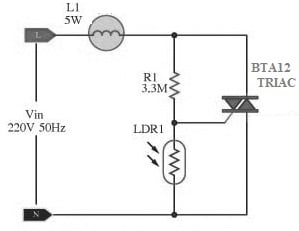
Lamp Dimmer Switch Circuit with BTA12 TRIAC
Working
A BTA12 TRIAC in the above dimmer circuit is used to manage the light depth continuously. Both the TRIAC & LDR in the circuit play a key role in the working of this lamp dimmer. The LDR in the circuit is used as a light sensor that provides maximum resistance to the flow of current in the absence of light & low resistance whenever light falls on it. So, a TRIAC in the circuit is a semiconductor device commonly used in AC systems to switch & power control. TRIAC can be turned ON by either a positive or a negative gate pulse, irrespective of the AC supply input polarity.
Whenever there is no light in the surroundings, then the LDR shows high resistance; thus, the voltage across the TRIAC’s gate terminal will be high. So this makes the TRIAC in the circuit drive the connected lamp to it & the light will glow very brightly whenever there is full darkness. Once the intensity of light is high, then the LDR shows very low resistance, so the voltage across the TRIAC will be zero or low. This will make the lamp in the circuit turn off whenever the intensity of light in the surroundings is higher. The TRIAC will reduce the lamp intensity slowly whenever there is an increase in light intensity & make the lamp brighter whenever there is a decrease in light intensity.
Advantages & Disadvantages
The advantages of BTA12 TRIAC include the following.
- BTA12 TRIAC is versatile because it can work with positive (or) negative voltages across the terminals.
- By using TRIAC, AC power control within an AC circuit is served better.
- It is a medium-power TRIAC that offers outstanding pulsed energy dissipation abilities & a low holding current,
- It can be triggered into conduction in any direction.
- It has a low holding current value, used for LED dimmers & motor control applications.
- This TRIAC commutation performance is high.
- TRIAC is not as dependable as SCR.
- It has less thermal resistance, including clip bonding.
- It has a medium current operation.
The disadvantages of BTA12 TRIAC include the following.
- This TRIAC cannot be utilized as an AC-to-AC converter.
- It will not generate a sinusoidal output.
- This TRIAC gets heated too much.
- It is not appropriate for DC applications.
- The dv/dt rating is extremely low compared to SCR.
Applications
The applications of BTA12 TRIAC include the following.
- BTA12 TRIAC is used in different applications like heating regulation, Static relays, motor speed controllers, phase control operation within light dimmers & induction motor starting circuits.
- These are used in LED dimming circuits, LED dimmers, Logic-level AC load switching, etc.
- This TRIAC is used in phase control, brilliance control within lamps, chopper designs, and speed control in motors and fans.
- It can be used as a phase angle function within applications like static relays.
- This TRIAC is appropriate for general-purpose mains power AC switching.
Please refer to this link for the BTA12 TRIAC Datasheet.
Thus, this is an overview of the BTA12 TRIAC, pin configuration, specifications, circuit, working, and its applications. It is a powerful semiconductor device that allows for sophisticated power & voltage control within AC circuits. It can conduct in two directions, triggered by a simple gating signal, making it a versatile tool within various electronic devices & systems. Here is a question for you: What is DIAC?