The high-performance TDA7294 IC was produced by an Italian electronic component manufacturer, namely STMicroelectronics. So, it is an upgraded TDA7293 version that utilizes a similar design, it provides lower distortion & higher output power. The TDA7294 is capable of delivering around 70W RMS into an 8Ω load and approximately 100W RMS into a 4Ω load under recommended operating conditions. Higher power levels are possible in bridge configurations. This IC has gained quick recognition in the audio amplifier marketplace; thus, it has become one of the main audio amplifier ICs. Additionally, STMicroelectronics has launched various kinds of power amplifier chips like TDA2030, TDA2050, TDA2050V, TDA2050H, TDA2030AH, TDA2030H, TDA2030AV, TDA2030V, etc. Thus, this article provides an overview of the TDA7294 IC, pinout, specifications, and applications.
What is TDA7294?
The TDA7294 IC is a monolithic chip available in a Multiwatt15 package. Thus, this IC is designed to be used in Hi-Fi field applications as an audio class AB amplifier which includes; top-class TV, self-powered loudspeakers & home stereo. This IC supplies the power into both 4W & 8W loads because of its wide operating voltage & high output current ability, even in high voltage supply rejection & poor supply regulation.
So to eliminate switching on-off noises, this IC’s remote operation can be simplified by an in-built muting function through a turn-on delay. The TDA7294 IC operates from a dual supply ranging from ±10 V to ±40 V (20–80 V total). Thus, the internal metal tab of this IC can be connected to the -Vs pin.
TDA7294 Working
The TDA7294 monolithic IC is an audio class AB amplifier in Hi-Fi applications. Its wide voltage and high output current ability allow it to drive 4 Ω and 8 Ω loads by supplying power. This IC has a DMOS output stage, so it is first utilized in Hi-Fi field applications mainly for audio signal amplification, which includes TV, self-powered loudspeakers, and many more.
Secondly, it includes its fault protection circuit, which protects from short-circuit to provide a thermal shutdown. In addition, this IC has a wide voltage supply range, even in poor voltage regulation. This IC is available in multi-watt packages.
TDA7294 IC Pin Configuration:
The pin configuration of the TDA7294 IC is shown below. This IC includes 15 pins, and each pin and its functionality are discussed below.
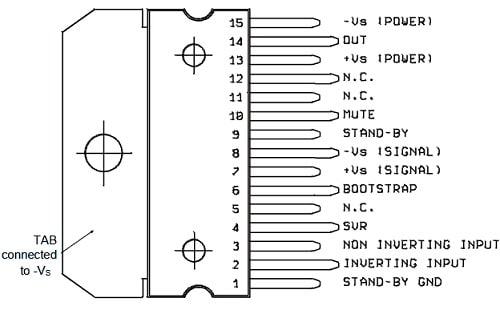
TDA7294 IC Pin Configuration
- Pin-1 (Stand by GND): It is a Standby Ground reference pin.
- Pins 2 &3 (Inverting and Non-inverting inputs): These are the input pins of the audio amplifier.
- Pin-4 (SVR): It is a supply voltage rejection pin that suppresses the changes and eliminates the noise from the o/p signal.
- Pins 5, 11, and 12 (NC): These are not connected pins of the IC.
Pin-6 (Bootstrap): This pin enhances the output swing by simply connecting a capacitor at this bootstrap pin. - Pins 7 & 8 (+Vs & -Vs): These two pins are the positive and negative voltage supply terminals of the IC.
- Pin-9 (Stand by): This pin runs o/p within a low current mode.
- Pin-10 (Mute): This pin disables the o/p signal.
- Pins-13 & 15 (-, + power supply): These are the Standby Ground reference and Positive Supply pins.
- Pin-14 (Out): This Out pin provides an amplified sound signal.
Features & Its Specifications:
The features and specifications of the TDA7294 IC include the following.
- TDA7294 IC is a 15-pin monolithic chip.
- It is available in the Multiwatt15 package.
- It has a very high operating voltage, like ±40V.
- This IC’s minimum operating voltage is ±10 V.
- It gives high o/p power that is up to 100 watts.
- This IC has a DMOS power stage, stand-by, or muting functions.
- This IC has very little distortion and noise.
- It has short circuit protection & thermal shutdown.
- Its maximum voltage supply is ±50V.
- Its maximum peak output current is 10Amps.
- Its operating ambient temperature is from 0 to 70 °C.
- Its storage temperature is 150 °Centigrade.
- Its junction temperature is 150 °Centigrade.
- Its open-loop voltage gain is 80 dB.
- The input bias current of this IC or Ib is 500 nA.
- Minimum closed loop voltage gain is 24 dB, normally 30 dB & max 40 dB.
Equivalent & Alternative ICs
Equivalent TDA7294 IC is NTE7165 and TDA7294 alternatives are; TDA7295, TDA7293 & LM3886.
Please refer to this link for the TDA7294 IC Datasheet.
120W TDA7294 IC Power Amplifier Circuit
A power amplifier plays a significant role in the electronics field, which amplifies the input signal’s power and provides a stronger o/p signal. So, the TDA7294 class-AB amplifier IC is used in power amplifier circuits that are capable of generating 120 watts maximum output power. So this amplifier is mainly designed for use in consumer and high-quality industrial applications like home theatre systems, professional audio equipment & Hi-Fi amplifiers.
The 120W TDA7294 power amplifier circuit is shown below. The required components and their connections are shown in the following diagram. So this circuit has some features which are discussed below.
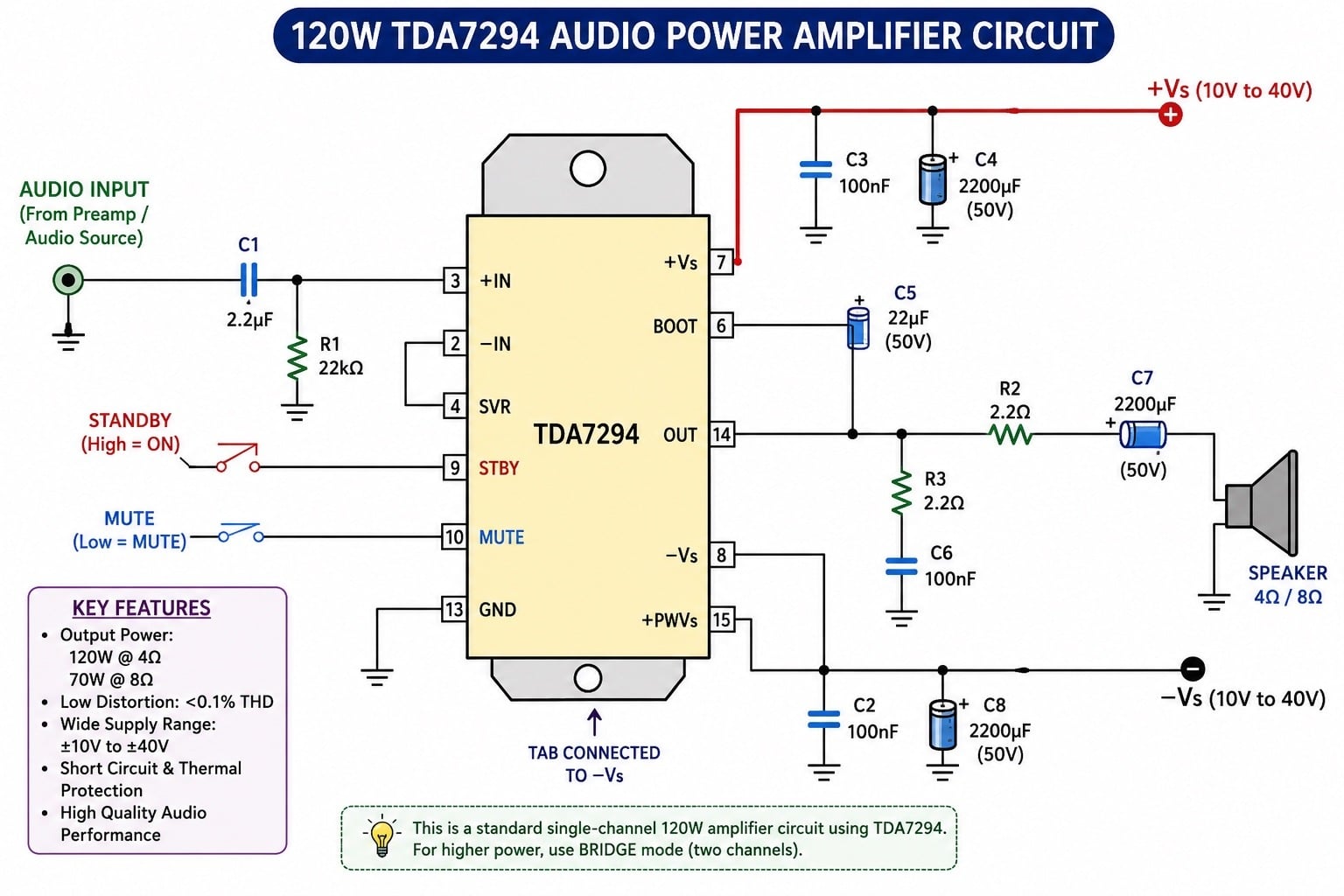
120W TDA7294 Power Amplifier Circuit
- This power amplifier circuit is very simple to design, thus it can be connected easily, making it suitable for beginners and hobbyists.
- This amplifier circuit delivers up to 120W of output power for each channel at 4 ohms load & 70 watts for each channel at 8 ohms load.
- This circuit has 50K ohms of high input impedance, which makes it well-suited for a broad range of audio sources.
- It has less distortion below 0.1% THD for different operating conditions.
- It has an in-built thermal and short circuit protection that guards the amplifier circuit from overheating.
Working of 120W TDA7294 Power Amplifier Circuit
The TDA7294-based power amplifier circuit amplifies a low-level audio signal from an audio source such as a smartphone, preamplifier, mixer, or media player, and delivers sufficient power to drive a 4Ω or 8Ω loudspeaker. The circuit uses the TDA7294 Class-AB audio amplifier IC as the main amplification stage, which includes input coupling, feedback, bootstrap, and power supply filtering and protection components.
Circuit Operation Overview
The complete signal flow can be understood in the following sequence:
Audio Input → Input Coupling → TDA7294 Amplification → Output Network → Speaker
The amplifier operates from a dual power supply (±Vs), allowing the output signal to swing both positively and negatively around ground without requiring a large output coupling capacitor.
1. Audio Input Stage
The audio signal enters the circuit through the input terminal and passes through capacitor C1 (2.2 µF).
Function of C1
- Blocks any DC component from the audio source.
- Allows only AC audio signals to enter the amplifier.
- Protects the amplifier from unwanted DC offsets.
Without C1, any DC voltage from the audio source could shift the amplifier’s operating point and
introduce distortion.
Function of R1 (22 kΩ)
The resistor connected to ground serves as:
- Input bias resistor.
- Input impedance stabilizer.
- Prevents the amplifier input from floating when no source is connected.
Together, C1 and R1 form a high-pass filter that removes extremely low-frequency noise and DC components.
2. Input Signal Amplification
The filtered audio signal is applied to the:
- Non-inverting input (+IN)
- Inverting input (-IN)
inside the TDA7294.
The internal amplifier consists of:
- Differential input stage
- Voltage gain stage
- Driver stage
- DMOS output stage
Differential Amplifier Stage
The differential stage compares:
- Input signal
- The feedback signal generates an error signal.
This error signal is amplified internally to ensure accurate reproduction of the original audio waveform.
The feedback system significantly reduces:
- Distortion
- Noise
- Gain variations
3. Power Amplification Stage
Inside the IC, the audio signal passes through a high-gain voltage amplifier stage and then reaches the DMOS output transistors.
The TDA7294 uses a:
- DMOS Class-AB Output Stage
This stage provides:
- High output current capability
- Low distortion
- High efficiency
- Excellent thermal stability
During operation:
Positive Half Cycle
When the input waveform becomes positive:
- Upper DMOS transistor conducts.
- Current flows from +Vs through the speaker.
- The speaker cone moves outward.
Negative Half Cycle
When the waveform becomes negative:
- Lower DMOS transistor conducts.
- Current flows toward −Vs.
- The speaker cone moves inward.
This continuous movement generates sound waves corresponding to the input audio signal.
4. Bootstrap Circuit (Pin 6)
The bootstrap capacitor C5 (22 µF) is connected to the BOOT pin.
Why Bootstrap is Required?
As the output voltage approaches the supply voltage, the output transistor requires additional gate drive voltage.
The bootstrap capacitor:
- Stores energy during one part of the signal cycle.
- Supplies additional drive voltage during peak output swings.
Advantages
- Increases output voltage swing.
- Improves power output.
- Reduces clipping.
- Enhances dynamic range.
Without the bootstrap capacitor, the amplifier would deliver significantly lower output power.
5. Power Supply Filtering Section
The amplifier uses a dual supply:
- +Vs
- −Vs
Capacitors C3 and C2 (100 nF)
These are high-frequency bypass capacitors.
Functions:
- Remove switching noise.
- Reduce supply ripple.
- Improve amplifier stability.
Capacitors C4 and C8 (2200 µF)
These are bulk filter capacitors.
Functions:
- Store energy during high-power music peaks.
- Smooth the DC supply.
- Prevent voltage sag.
During heavy bass notes, the amplifier may draw several amperes of current. These capacitors
act as local energy reservoirs.
6. Standby Control (Pin 9)
The STBY pin controls the standby mode.
Standby Activated
When the standby pin is driven appropriately:
- Internal circuits shut down.
- Power consumption becomes extremely low.
Standby Released
When the pin is activated:
- Amplifier becomes operational.
- The output stage starts functioning.
This feature is useful for:
- Remote-controlled amplifiers.
- Home theatre systems.
- Energy-saving audio equipment.
7. Mute Function (Pin 10)
The MUTE pin disables the audio output without shutting down the IC.
Why is Mute Needed?
When an amplifier powers ON or OFF:
- Voltage transients may occur.
- Loud “POP” noises may be heard.
The mute function:
- Temporarily disables audio output.
- Eliminates switching noise.
- Improves user experience.
This feature is commonly used in professional audio equipment.
8. Output Stage and Speaker Network
The amplified signal appears at:
Pin 14 (OUT)
The output network includes:
- R2 (2.2 Ω)
- R3 (2.2 Ω)
- C6 (100 nF)
This combination forms a Zobel Network.
Function of Zobel Network
The speaker is not purely resistive.
Its impedance changes with:
- Frequency
- Voice coil inductance
The Zobel network:
- Stabilizes the amplifier at high frequencies.
- Prevents oscillation.
- Improves frequency response.
Without this network, the amplifier may become unstable when driving reactive loads.
9. Speaker Operation
The output signal finally reaches the speaker.
Positive Output Voltage
The speaker cone moves forward.
Negative Output Voltage
- The speaker cone moves backward.
- The alternating movement produces sound waves that correspond exactly to the amplified input signal.
- Because the amplifier operates from a dual supply, the output can swing both above and below ground, enabling high power delivery without a large output coupling capacitor.
10. Protection Features During Operation
One major advantage of the TDA7294 is its built-in protection circuitry.
Thermal Protection
If junction temperature exceeds the safe limit:
- Output power is reduced.
- The amplifier shuts down if necessary.
Short-Circuit Protection
If speaker terminals accidentally short:
- The output current is limited.
- Internal circuitry is protected.
Safe Operating Area (SOA) Protection
The IC continuously monitors:
- Voltage
- Current
- Power dissipation
to prevent damage to the output transistors.
What Happens When Music Plays?
Suppose a 100 mV audio signal is applied at the input.
- C1 removes any DC component.
- The differential amplifier processes the signal.
- Internal gain stages amplify the voltage.
- DMOS output stage amplifies the current.
- Bootstrap capacitor increases output swing.
- Power supply capacitors provide instantaneous current.
- Zobel network maintains stability.
- The speaker receives a high-power replica of the original audio waveform.
As a result, a tiny millivolt-level audio signal is converted into a powerful signal capable of delivering approximately 70W RMS into an 8Ω speaker or 100W RMS into a 4Ω speaker under recommended operating conditions.
The TDA7294 power amplifier circuit works by accepting a low-level audio signal, amplifying its voltage and current through a Class-AB DMOS output stage, and delivering high-quality audio power to a loudspeaker. Components such as the bootstrap capacitor, supply filtering capacitors, standby and mute controls, and the Zobel stabilization network ensure high output power, low distortion, excellent stability, and reliable operation, making the TDA7294 one of the most widely used Hi-Fi audio amplifier ICs for home theatre systems, powered speakers, and professional audio equipment.
Advantages & Disadvantages
The advantages of the TDA7294 IC include the following.
- The TDA7294 IC delivers power up to 100W at 8 ohms & 120W at 4 ohms.
- It has less noise and low distortion, which makes it perfect for high-fidelity audio-based applications.
- This has a ±40V high operating voltage range.
- This IC has an in-built standby and muting functions, which simplifies remote operation to avoid on-off switching noises.
- It has thermal shutdown & short-circuit protection.
- It tolerates different resistances.
- It is not expensive and very easy to replace.
- This IC has high power efficiency.
- This IC has low distortion, low noise, good ripple rejection & operates from a broad range of voltage supplies.
The disadvantages of the TDA7294 IC include the following.
- The breakdown procedure within this IC restricts the secure operating production region because it needs a specific o/p from their power supply.
- The safe operating area existence can cause the circuit layout to be modified more & also increase the circuit intensity.
- These ICs cannot operate safely beyond the specified supply voltage limits.
- These are fragile; thus, they cannot withstand a high-voltage operation.
- This IC has a limited power rating.
TDA7294 IC Applications
The applications of the TDA7294 IC include the following.
- Engineers widely use the TDA7294 IC in circuits that demand high efficiency and high-power amplification.
- Designers intend it for use as an audio class AB amplifier in various Hi-Fi applications, including self-powered loudspeakers, home stereos, and premium televisions.
- This high-performance audio amplifier IC caters to diverse audio needs, such as car audio systems, professional audio equipment, and home theater setups.
- With its ability to deliver up to 100W of power to an 8-ohm load, it excels in driving sound systems.
- You’ll find the TDA7294 in audio class AB amplifiers, Hi-Fi systems, bridge applications, subwoofers, stereo systems, public address systems, powered speakers, studio monitors, home theaters, loudspeakers, and professional amplifiers.
- These are used in radio and television broadcasts, conventional subwoofers, and standard bridge circuitry.
Thus, this is an overview of the TDA7294 IC, which is a high-performance power amplifier chip available in a Multiwatt15 package. This IC has high power output & high-fidelity sound quality capability, so used widely in home theater, car audio, hi-fi, etc. These ICs can also be available in different versions to meet the requirements of different applications. So this high-performance IC provides a high-reliability solution for the audio amplifier market. Here is a question for you: What is the TDA2030 IC?