2SC1345 is a BJT from the NPN transistor family composed of silicon semiconductor material. This transistor includes three layers mainly wherever one layer is a p-doped layer & other two layers are n-doped where the p-doped layer is arranged in between the remaining two n-doped layers. This is a bipolar junction transistor, so both the charge carriers play a significant role in the transistor conductivity that’s why these are known as bipolar devices. This transistor works when the change in a small current at the base terminal is utilized to produce a large current at the emitter and collector terminals. So these are known as current-controlled devices. This article overviews the 2SC1345 transistor, its workings, and its applications.
What is a 2SC1345 Transistor?
2SC1345 is an NPN low-frequency and low-noise-based transistor available in a TO-92 package. This transistor is mainly designed for use in audio amplification applications. This is a low signal amplifier transistor including 50V CE voltage & 100mA collector current. The high gain value of this transistor ranges from 250 to 1200 to make it appropriate for amplifier designs but it is suggested not to utilize it as a switch because of its 50V high CE voltage & fairly 100mA low collector current.
This transistor gain value mainly depends on the transistor’s part number. So 2SC1345D transistor gain value ranges from 250 to 500, 2SC1345E transistor gain value ranges from 400 to 800 and 2SC1345F transistor gain value ranges from 600 to 1200.
While looking for a suitable transistor for your application based on a few factors, it is very important to look into a few points on How to Select a Transistor.
Working Principle
Whenever voltage supply is provided at the base terminal, then it biases the device thus, current starts supplying from the collector terminal to the emitter. Bipolar junction transistors are not symmetrical so if we exchange the two terminals then these terminals will stop working in the forward active region but start functioning in reverse active mode. These devices non-symmetry is because of three terminals different doping concentrations.
Thus, if the base voltage is > 0.7Volts, then the NPN transistor will get forward biased and current supplies from the Collector to the Emitter terminal. Similarly, if the base voltage is < 0.7V, then the transistor will be reverse-biased.
Pin Configuration:
The pin configuration of the 2SC1345 transistor is shown below. This is an epitaxial low-noise silicon transistor that includes three terminals emitter, base, and collector. These three terminals have different doping concentrations. So the base terminal is ten times more doped as compared to the collector terminal. The emitter is highly doped & the collector is lightly doped.
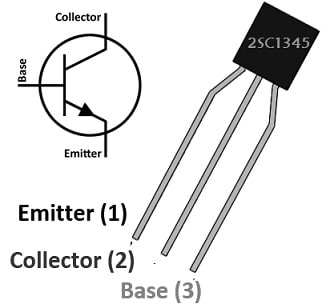
2SC1345 Transistor Pin Configuration
- Pin-1 (Emitter): This is the left side pin that supplies the majority of charges and also current drains out throughout this terminal.
- Pin-2 (Collector): This is the center pin that is larger slightly as compared to the emitter terminal which collects the charge carriers from the emitter terminal. Generally, a load is connected to this pin.
- Pin-3 (Base): This is the rightmost pin which controls the flow of current from the emitter terminal to a collector by simply providing the necessary biasing voltage toward the base terminal.
Features & Specifications:
The features and specifications of the 2SC1345 transistor include the following. Whenever working with this transistor, confirm these ratings don’t go above the absolute maximum ratings or else they can harm the device. In addition, if these ratings are applied above the necessary time, then they affect the reliability of the device.
- This is an NPN low-noise amplifier transistor.
- It is available in the To-92 Package.
- Its collector-to-emitter voltage or VCEO is 50 Volts.
- Its collector-to-base voltage or VCBO is 550 Volts.
- The emitter to base voltage or VEBO is 5.0 Volts.
- Its continuous collector current or IC is 100 mAmps.
- DC gain or hFE ranges from 250 to 1200.
- Its collector current is 0.1 amps.
- Its power dissipation is 0.2W.
- This transistor base current is 0.05 amps.
Equivalents & Other Transistors
Equivalent 2SC1345 transistors are; 2SC2240 and KSC1845FTA. Other NPN amplifier transistors are; MPS06, NTE123AP, BC337, 2N5551, and 2SC2879. The complementary 2SC1345 transistor is the BC416 PNP transistor.
Replacing a suitable transistor in any circuit based on requirement is very important. To know how to replace it, please refer to this; Replacing Transistors in Electronic Circuits: Factors and Considerations.
Low-frequency Amplifier Circuit with 2SC1345 Transistor
The low-frequency amplifier circuit using a 2SC1345 transistor is shown below. This circuit simply works like other types of amplifier transistors but it operates at low frequencies. The required components to make this circuit mainly include audio input, basic resistors, capacitors, and a speaker. Connect the circuit as per the circuit diagram shown below.
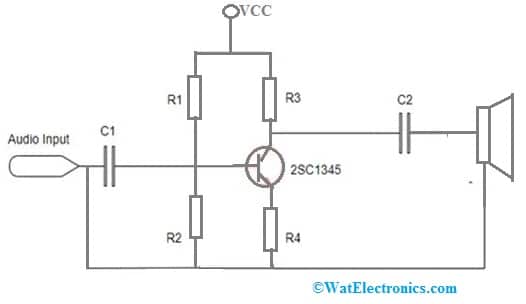
Low-frequency Amplifier Circuit with 2SC1345
Working
In the above circuit, the base terminal is simply connected through an input signal. The collector terminal provides an input voltage to activate the active mode & operate this transistor as an amplifier.
The resistors in the circuit are responsible for controlling the gain by simply handling the current flow. Coupling capacitors are utilized to keep away from signal distortion and also to control the amplifier gain as a necessity. The circuit frequency response mainly depends on these capacitors.
Whenever an input low-band frequency signal is provided to an amplification system, the signal arrives at the transistor’s base terminal, gets boosted & is returned in the high-gain signal form. In an audio signal case, it outputs a higher sound with excellent quality.
Connecting a base resistor to the base terminal of the transistor is mandatory to avoid it being damaged. So, Please refer to this link for; Choosing Base Resistance for Transistors in Electronic Circuits.
Applications
The 2SC1345 transistor applications include the following.
- 2SC1345 transistor is used in electronic Ballasts, common power amplifiers, voltage regulator circuits, and in modern electronic circuits.
- These transistors are used in astable and bistable multivibrator circuits.
- It is used in energy-saving lights, high-frequency power transform, high-switching power supply, etc.
- This transistor supports below 0.1A loads, preamplifiers, low current switches, oscillator circuits, audio frequency amplifier circuits, and low power amplifier designs.
Please refer to this link for the 2SC1345 Transistor Datasheet.
Thus, this is an overview of the 2SC1345 transistor, pinout, specifications, circuit, working, and its applications. It is an NPN transistor whose conductivity is carried out mainly by the majority of charge carriers like electrons. This transistor is mainly utilized for amplification and switching purposes. Here is a question for you, what is 2N5551 transistor?