A transistor is a small semiconductor device that changes or simply controls voltage or current flow within a circuit. Generally, transistors include three terminals or layers made with semiconductor material. So it is used in various electronic projects to work as a switch or an amplifier. Further transistors are available in types like; PNP and NPN transistors. This article provides an overview of the 2N4406 transistor, pinout, specifications, and its applications.
What is a 2N4406 Transistor?
2N4406 is a PNP-type bipolar junction transistor. The conduction in this transistor can be carried out by the charge carrier’s movement but holes will be the majority of charge carriers. Generally, it is a PNP transistor and is available in a plastic TO-39 package. In this transistor, the N-doped layer is simply sandwiched in between the two P-doped layers. This transistor includes three terminals; emitter, base, and collector where the N layer is the base terminal and the remaining two P-layers will be emitter and collector terminals.
Working
This transistor works as; the small amount of current supply at the base terminal is used for controlling the large amount of current at the remaining two terminals. It is a PNP transistor thus base terminal is negative as compared to the emitter terminal.
Generally, most of the transistors work like a switch because whenever we provide a small voltage at the base terminal, then it controls a large amount of current at the collector and emitter side. Thus, the switch is considered as ON. Whenever there is no voltage at the base terminal then the switch will be considered as OFF. So this transistor is known as a current-controlled device.
While looking for a suitable transistor for your application based on a few factors, it is very important to look into a few points on How to Select a Transistor.
Pin Configuration:
The pin configuration of the 2N4406 transistor is shown below. This transistor includes three terminals; emitter, base, and collector which are discussed below.
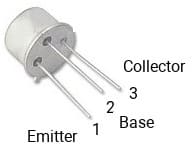
2N4406 Transistor Pin Configuration
- Pin-1 (Emitter): The emitter terminal size is moderate and heavily doped. This terminal is normally connected to the power supply which emits the charge carriers and is always forward-biased concerning the base terminal.
- Pin-2 (Base): This is the middle terminal, used to activate the transistor by switching ON & OFF. The base terminal is extremely thin and lightly doped as it provides the charge carriers to the base terminal.
- Pin-3 (Collector): The collector terminal is moderately doped and can gather the charge carriers emitted by the emitter terminal. This is normally connected to a load.
Features & Specifications:
The features and specifications of the 2N4406 transistor include the following.
- This transistor includes three terminals.
- It is a PNP-type Silicon Transistor.
- 2N4406 transistor is available in the TO39 case.
- Max collector power dissipation or Pc is 1.2 Watts.
- Collector to base voltage or |Vcb| maximum is -80 Volts.
- Collector to emitter voltage or |Vce| maximum is -80 Volts.
- Emitter to base voltage or |Veb| maximum is -5 Volts.
- Maximum collector current or |Ic max| is -2 Amps.
- Collector capacitance or Cc is 15 pF.
- The transition frequency or ft is 50 MHz.
- Operating & Storage junction temperature or Tj maximum is -65 to +200 °C.
- The minimum forward current transfer ratio or hFE is 25.
- Collector dissipation is 8.75 Watts.
- DC gain or hfe is 30 to 120.
- Collector cut-off current or ICBO is 25 μAmps.
- The emitter cut-off current or IEBO is 25 μAmps.
- Collector-emitter saturation voltage or VCE(sat)) is 0.7 V.
Equivalent & Complementary Transistors
Equivalent 2N4406 transistors are; 2N5322, SFT4407, 2N6190, 2N6192 or 2N5333. The complementary 2N4406 transistor is 2N4403. Alternative 2N4406 transistors are; 2N4406PBFREE, 2N3789CECC-D, 2SD1583-ZL, KSH210, BCP52TC, BSP31TRL, BCP53, MJD32 and 2N4406TIN/LEAD.
Replacing a suitable transistor in any circuit based on requirement is very important. To know how to replace it, please refer to this; Replacing Transistors in Electronic Circuits: Factors and Considerations.
Operating Regions of 2N4406 Transistor
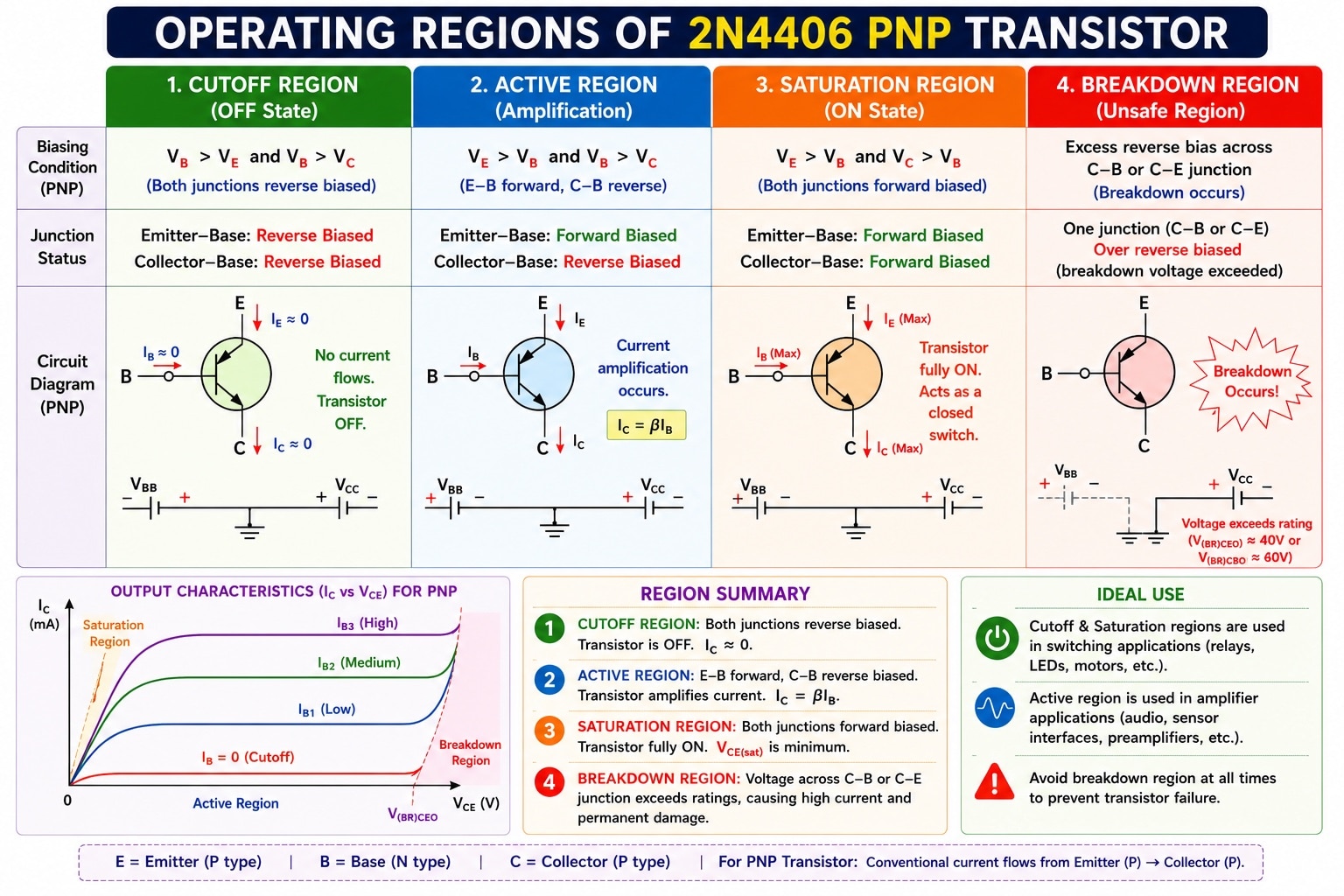
How to Use 2N4406 Transistor in a Circuit for a Long Time?
To use the 2N4406 transistor within your circuit for the long term then it is significant not to use the transistor above the defined values. It is also recommended to stay always some numbers under the maximum value for security & also to get long-term performance. Do not drive any load with this transistor above the specified current supply. This transistor must be operated always below 40V DC load. A suitable base resistor must be used with this transistor in a circuit to protect from overvoltage. Do not operate or store this transistor in below -65 centigrade and above +200 degrees centigrade temperature.
Automatic Night Lamp Circuit with 2N4406 Transistor
An automatic night lamp circuit with a 2N4406 transistor and TRIAC is shown below. Generally, TRIAC is a 3-terminal electrical component or bidirectional triode thyristor. It is a solid-state high-speed device, capable of switching and controlling AC power within both sinusoidal waveform directions. These are solid-state devices that are used to control motors, heaters, and lamps.
The required components to make this circuit mainly include; 1N4007 diodes, 330nF/40V ceramic capacitor, 330µF/25V electrolytic capacitor, 220V AC supply, 6.2V Zener diode, LDR, 2N3906 or 2N4403 Transistor, BT136 TRIAC, 1M resistor, 50K variable resistor, 230V lamp, etc.
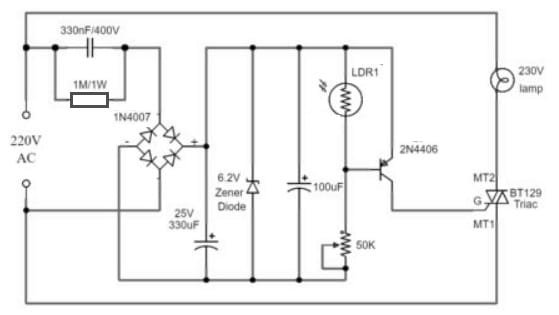
Automatic Night Lamp Circuit with 2N4406 Transistor
Working
This circuit includes two sections a capacitor power supply & an automatic night lamp. In the first section of the circuit, any transformer is not used but it is connected directly to the AC mains supply through a capacitor power supply. So this capacitor power supply circuit uses a 330nF capacitor which drops the mains voltage.
Here, this main voltage is supplied throughout a bridge rectifier to change it into DC, after that it is filtered through a 330uF smoothing capacitor. A Zener diode is used to step down the voltage for the next part.
In the above circuit, the second part is a dark sensor circuit that uses a light-dependent resistor to detect the dark. Whenever there is no light dropping on the LDR then its resistance will be reduced and it will prevent the voltage from supplying to the GND. So this transistor will begin conducting & it will switch ON the TRIAC. Once the TRIAC is turned ON, the AC supply will flow to activate the bulb.
Some precautions need to be taken while operating this circuit such as; you need to be very careful because AC mains voltage gives you a lethal shock. You need knowledge of AC line voltages. This circuit is used in electrical appliances, emergency lights, bedside lamps, and houses.
Connecting a base resistor to the base terminal of the transistor is mandatory to avoid it being damaged. So, Please refer to this link for; Choosing Base Resistance for Transistors in Electronic Circuits.
Applications
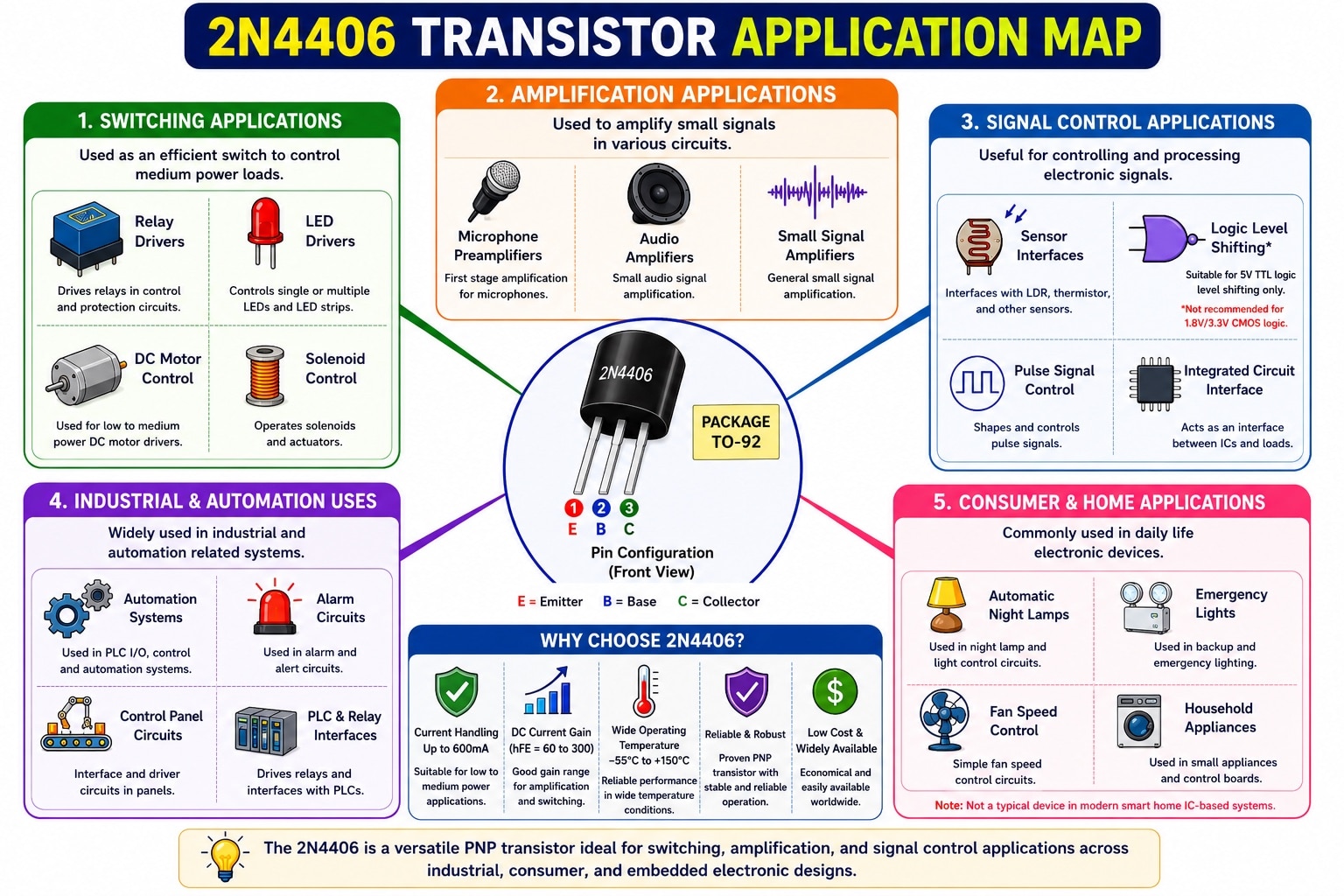
The applications of the 2N4406 transistor include the following.
- The 2N4406 transistor is preferred in mid and low-power switch and amplifier applications.
- This is a PNP transistor, thus used in microphone pre-amplifier, simple switching, and lighting systems applications.
- This transistor is used in sensor circuits, relay drivers, signal amplifiers, audio amplifiers, etc.
- This transistor can be used in different circuits to switch ON & OFF relay switches, various types of LEDs, MOSFET controlling & other high-power transistors within electrical circuits, control integrated circuits, etc.
- 2N4406 transistor is also used at the o/p of the circuit like a small amplifier to drive a speaker or as an amplifier directly within various audio-related circuits.
- It can also be utilized as a preamplifier or a microphone preamplifier for various small audio signals.
- This transistor can also amplify any small signal.
Please refer to this link for the 2N4406 transistor datasheet.
Thus, this is an overview of the 2N4406 transistor, pinout, specifications, circuit, working, and its applications. Here is a question for you, what is 2N4403 transistor?