The increasing integration of embedded systems into automotive electronics, industrial automation, medical equipment, consumer electronics, and Internet of Things (IoT) infrastructure has fundamentally changed the way these devices are designed, developed, and maintained. As discussed in the previous articles, modern embedded systems are no longer limited to performing isolated control operations. They frequently communicate with external networks, exchange sensitive information, interact with other electronic controllers, and execute firmware that directly influences physical operations.
This growing connectivity introduces security challenges that cannot be addressed through hardware protection or secure firmware implementation alone. Engineers must also understand the nature of potential threats, identify weaknesses within the system, evaluate the consequences of successful attacks, and determine which security controls are necessary to reduce the associated risks.
This is where cybersecurity fundamentals become important.
Embedded Cybersecurity fundamentals provide a structured approach to protecting systems, information, and operations against unauthorized access, modification, disruption, and misuse. It establishes the objectives that a secure system should achieve and provides methodologies for identifying and managing security risks.
In embedded environments, these principles must be interpreted in the context of the device’s hardware architecture, firmware implementation, communication interfaces, operational environment, and intended functionality.
For example, the confidentiality of cryptographic keys stored within a microcontroller, the integrity of firmware executed during startup, and the availability of an industrial controller during normal operation are all different security requirements. Each requires specific protection mechanisms and must be evaluated according to the potential consequences of compromise.
This article explores the fundamental concepts used in cybersecurity engineering, beginning with the Confidentiality, Integrity, and Availability (CIA) Triad. It then examines threat actors, attack vectors, vulnerabilities, exploits, and security risks before introducing practical risk assessment methodologies for embedded systems.
Understanding these concepts provides the foundation for identifying attack surfaces and developing structured threat models in the subsequent articles.
Establishing Security Objectives: The CIA Triad
Every cybersecurity implementation begins with a clear understanding of what needs to be protected and why. A security mechanism cannot be evaluated effectively without first defining the security objective it is intended to achieve. For example, encryption is useful when sensitive information must remain confidential, while digital signatures are used to verify the authenticity and integrity of firmware or other trusted data.
The Confidentiality, Integrity, and Availability model, commonly known as the CIA Triad, provides one of the most widely recognized foundations for defining these objectives. The three principles describe the fundamental security properties that a system should maintain.
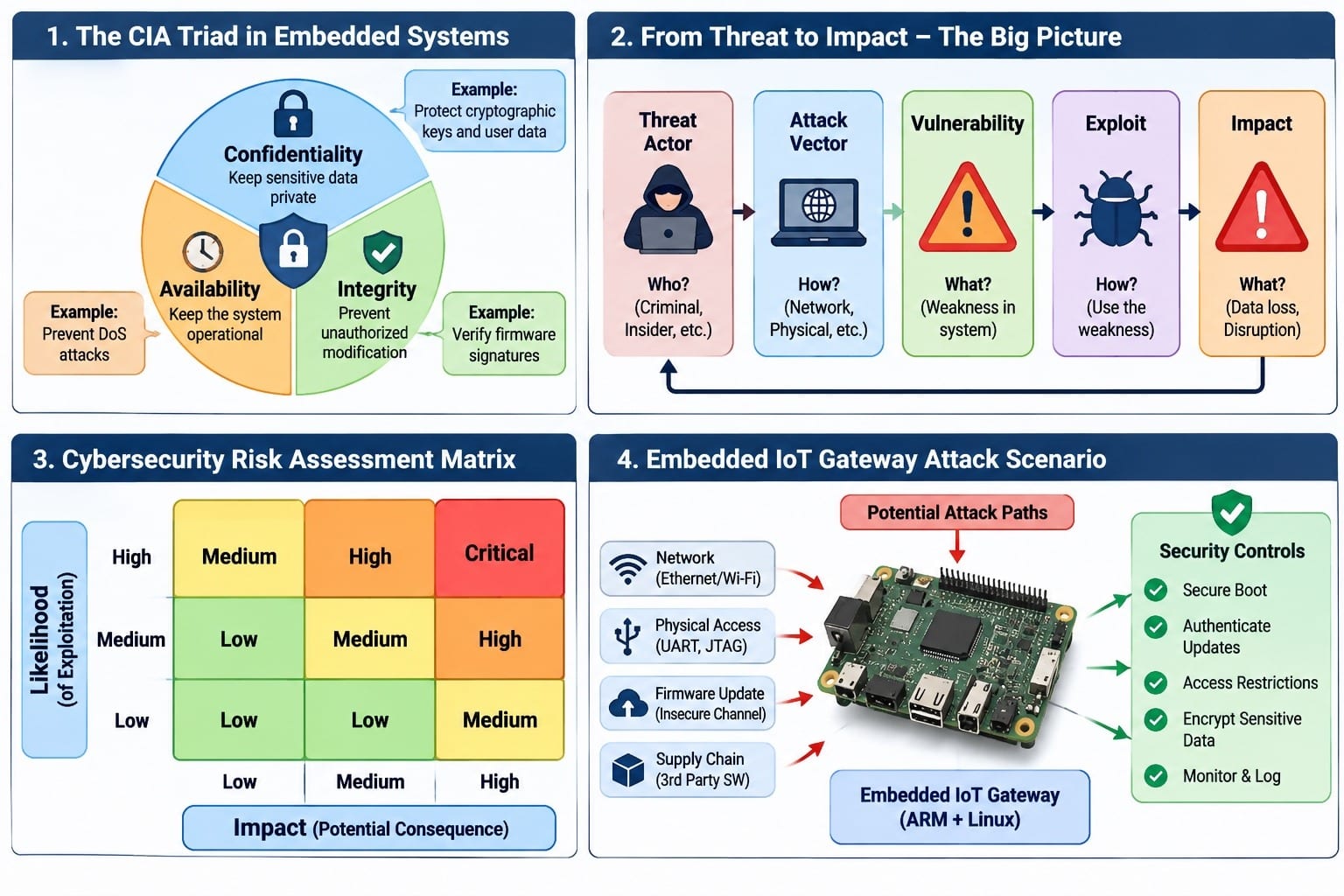
Cybersecurity Fundamentals for Embedded Systems
Confidentiality
Confidentiality ensures that information is accessible only to authorized individuals, devices, processes, or systems. Embedded devices frequently process information that must remain protected throughout its storage, transmission, and execution. Examples include:
- Cryptographic keys and certificates.
- Device authentication credentials.
- Proprietary firmware and intellectual property.
- Network configuration parameters.
- User information and personal data.
- Industrial configuration and operational information.
Consider an embedded IoT device that communicates with a cloud platform using TLS. During communication, the device may use cryptographic keys, authentication credentials, and session information to establish a secure connection.
If these credentials are stored in an unprotected memory region or exposed through an unrestricted debugging interface, an attacker with sufficient access may be able to extract them.
The consequences may extend beyond the individual device. If identical credentials or cryptographic keys are shared across an entire device fleet, compromising one device may potentially affect multiple deployed products.
Maintaining confidentiality therefore requires more than encrypting network traffic. It involves protecting sensitive information throughout its lifecycle.
Common confidentiality mechanisms include:
- Symmetric and asymmetric encryption.
- Secure key storage.
- Authentication and authorization.
- Access control mechanisms.
- Hardware-backed security.
- Secure memory isolation.
- Protection of diagnostic and debugging interfaces.
In resource-constrained embedded systems, the selection of these mechanisms must also consider processing capabilities, memory limitations, power consumption, and hardware support.
Integrity
Integrity ensures that information, firmware, configuration parameters, and system operations remain accurate and protected against unauthorized modification.
In embedded systems, integrity is particularly important because software and configuration data directly influence how physical devices operate.
Consider an automotive electronic control unit that executes firmware responsible for controlling a particular vehicle subsystem. If an attacker modifies the firmware without authorization, the resulting behavior may differ from the intended operation.
Similarly, unauthorized modification of industrial controller configuration parameters could affect machine operation or production processes.
Integrity protection must therefore cover both executable software and the information processed by the system.
Common mechanisms include:
- Cryptographic hash functions.
- Message Authentication Codes (MACs).
- Digital signatures.
- Secure boot.
- Authenticated firmware updates.
- Protected configuration storage.
- Secure communication protocols.
- Access control and memory protection.
It is important to distinguish between integrity verification and authenticity verification.
A cryptographic hash can detect changes when compared against a trusted reference value. However, a hash alone does not establish who created the information.
Digital signatures and message authentication mechanisms provide additional means of establishing authenticity, depending on the cryptographic architecture.
For embedded devices, this distinction becomes particularly important during firmware updates and secure boot implementation.
Availability
Availability ensures that systems, services, and resources remain accessible and operational when required.
Unlike many general-purpose computing applications, embedded systems frequently operate under strict timing and reliability requirements.
An industrial controller may need to execute control operations continuously. An automotive ECU must respond to specific events within defined timing constraints. A medical monitoring device may need to maintain continuous access to critical monitoring functions.
An attacker may attempt to affect availability through denial-of-service attacks, resource exhaustion, malicious firmware, communication disruption, or exploitation of software vulnerabilities.
However, availability problems are not necessarily caused by deliberate attacks. Hardware failures, software defects, power interruptions, and incorrect configurations may also affect system operation.
For this reason, availability engineering must consider both cybersecurity threats and operational resilience.
Common protection mechanisms include:
- Resource management and execution limits.
- Watchdog timers.
- Fault detection and recovery.
- Redundant communication paths where appropriate.
- Secure recovery and firmware rollback mechanisms.
- Network filtering and traffic control.
- Robust error handling.
- System health monitoring.
The CIA Triad should not be treated as three independent security requirements. In practice, a security failure may affect multiple properties simultaneously.
For example, malicious firmware installation may compromise integrity, expose confidential information, and disrupt device availability.
The relationship between these three objectives is illustrated below.
|
Security principle |
Primary objective |
Embedded system example |
| Confidentiality | Prevent unauthorized information disclosure | Protect cryptographic keys stored in a microcontroller |
| Integrity | Prevent unauthorized modification | Verify firmware signatures before execution |
| Availability | Maintain reliable system operation | Prevent resource exhaustion in an industrial controller |
Although the CIA Triad establishes the primary security objectives, these principles alone do not explain how an attack occurs. To understand that, it is necessary to examine the entities, actions, and weaknesses involved in a security incident.
Understanding Threat Actors and Their Motivations
- A threat actor is an individual, group, organization, or other entity capable of carrying out actions that may compromise a system’s security.
- Threat actors differ in their objectives, technical capabilities, available resources, and access to the target environment.
- In embedded cybersecurity, identifying potential threat actors is important because the security requirements of a device depend partly on who may attempt to compromise it and what they hope to achieve.
- For example, an attacker targeting a consumer IoT camera may be primarily interested in obtaining unauthorized access to video streams, while an attacker targeting an industrial controller may be interested in disrupting production or manipulating operational parameters.
Common categories of threat actors include the following.
Cybercriminals
Cybercriminals generally pursue financial gain through unauthorized access, information theft, extortion, or other criminal activities.
Their activities may involve exploiting vulnerable IoT devices, compromising network-connected embedded products, stealing credentials, or using compromised devices as part of larger botnets.
Weak authentication, outdated firmware, and exposed network services can make embedded products attractive targets.
Nation-State and Advanced Threat Groups
Nation-state-associated groups and other highly capable threat organizations may target embedded infrastructure for espionage, strategic disruption, or long-term unauthorized access.
Their targets may include industrial control systems, telecommunications infrastructure, automotive technology, and critical infrastructure.
Such attackers may have access to significant resources, specialized technical expertise, and advanced exploitation capabilities.
Malicious Insiders
Insider threats originate from individuals who already possess some level of legitimate access to an organization, development environment, manufacturing facility, or deployed system.
For example, an employee or contractor with access to firmware repositories may intentionally introduce unauthorized code into a product.
Similarly, inappropriate access to manufacturing systems may expose device credentials or security configuration data.
Insider threats are particularly important in embedded product development because security-sensitive information is handled across multiple teams and organizational boundaries.
Security Researchers
Security researchers investigate products to identify vulnerabilities and improve their security.
Their activities may involve firmware analysis, protocol testing, reverse engineering, vulnerability discovery, and controlled exploitation.
Although security research is generally conducted to improve security, researchers may discover vulnerabilities that could also be abused by malicious actors.
Responsible vulnerability disclosure and coordinated remediation are therefore important parts of product security management.
Supply-Chain Threat Actors
Modern embedded products depend on semiconductor manufacturers, software vendors, development tools, third-party libraries, manufacturing facilities, and external service providers.
A compromise involving any of these dependencies may affect the security of the final product.
For example, an attacker may attempt to compromise a software dependency, modify firmware during manufacturing, or introduce malicious components into the development or provisioning process.
Supply-chain security has therefore become an important consideration in embedded product development.
Understanding threat actors provides useful context, but identifying who may attack a device is only part of the security assessment. Engineers must also understand how those actors could interact with the system.
This leads to the concept of attack vectors.
Attack Vectors and Common Attack Methods in Embedded Systems
An attack vector is the path or method through which an attacker attempts to gain access to a system, exploit a vulnerability, or affect its operation.
The available attack vectors depend on the device architecture, physical accessibility, network connectivity, software implementation, and operational environment.
As established in Article 02, embedded platforms contain multiple hardware and software interfaces. These interfaces create different opportunities for interaction and therefore require different security protections.
Some of the commonly encountered embedded system attack vectors include the following.
Physical Access Attacks
Physical attacks involve direct access to the device or its electronic components.
An attacker with physical access may attempt to interact with debugging interfaces, inspect external memory, manipulate hardware signals, or extract information from accessible components.
Common interfaces of interest include:
For example, an embedded device may expose a UART console that provides access to diagnostic information or a command-line environment.
If the interface does not implement appropriate access restrictions, an unauthorized individual may obtain information that should remain protected.
Physical attacks may also involve advanced techniques such as fault injection and side-channel analysis.
These techniques will be examined in greater detail in the hardware security section of this series.
Network-Based Attacks
Network-based attacks exploit weaknesses in the communication interfaces or services exposed by an embedded device.
Connected devices may communicate using Ethernet, Wi-Fi, Bluetooth, cellular networks, MQTT, HTTP, CoAP, or other protocols.
Potential weaknesses include:
- Weak authentication.
- Insecure network services.
- Improper input validation.
- Unencrypted communication.
- Incorrect certificate validation.
- Vulnerable protocol implementations.
- Inadequate authorization.
For example, an IoT gateway that accepts remote configuration commands without properly authenticating the requesting system may allow unauthorized modification of device settings.
Network security must therefore consider both the communication protocol and the application logic that processes incoming messages.
Firmware-Based Attacks
Firmware attacks target the software responsible for controlling the embedded device.
An attacker may attempt to extract, modify, replace, or analyze firmware to identify weaknesses.
Potential attack opportunities include insecure bootloaders, unsigned firmware updates, exposed debug functionality, hardcoded credentials, and vulnerable third-party software components.
Firmware attacks are particularly significant because firmware frequently operates with extensive privileges and direct access to hardware resources.
A successful compromise may therefore affect the entire device.
Memory and Software Exploitation
Memory-related vulnerabilities arise when software incorrectly handles memory allocation, pointers, buffers, or input data.
Examples include:
- Buffer overflows.
- Stack overflows.
- Heap corruption.
- Use-after-free vulnerabilities.
- Integer overflows.
- Out-of-bounds memory access.
- Such vulnerabilities may allow an attacker to crash an application, corrupt data, bypass intended execution restrictions, or potentially execute unauthorized code.
Their impact depends on the processor architecture, memory protection mechanisms, compiler configuration, and software privileges.
Supply-Chain Attacks
Supply-chain attacks target the development, manufacturing, distribution, or maintenance processes associated with an embedded product.
Potential targets include firmware repositories, third-party libraries, development tools, manufacturing systems, and device provisioning infrastructure.
For example, if a compromised third-party library is incorporated into firmware, the resulting vulnerability may affect every device that uses that software component.
This demonstrates why product security cannot be limited to the final firmware image. The complete development and manufacturing ecosystem must also be considered.
The attack vectors described above represent different ways of interacting with a system. However, an attack vector alone does not guarantee successful compromise. It generally requires an underlying weakness to exploit.
Such weaknesses are known as vulnerabilities.
Understanding Vulnerabilities in Embedded Systems
A vulnerability is a weakness in the design, implementation, configuration, or operation of a system that may be exploited to violate its security requirements.
Vulnerabilities can exist at almost every layer of an embedded product, including hardware, boot firmware, application firmware, operating systems, communication stacks, and manufacturing processes.
Their severity depends on several factors, including the accessibility of the vulnerable component, the privileges required for exploitation, the complexity of the attack, and the potential impact.
The following categories represent common vulnerability classes encountered in embedded environments.
Authentication and Authorization Weaknesses
Authentication verifies the identity of an entity attempting to access a device or service.
Authorization determines which operations that authenticated entity is permitted to perform.
These mechanisms are closely related but serve different purposes.
An embedded device may implement authentication but still contain authorization weaknesses.
For example, a device may successfully authenticate an administrator but fail to restrict access to security-critical configuration functions.
Similarly, an IoT device using default credentials across multiple products may expose itself to unauthorized access.
Common weaknesses include:
- Hardcoded credentials.
- Default passwords.
- Weak password policies.
- Missing mutual authentication.
- Inadequate access control.
- Incorrect privilege assignment.
Appropriate protection requires secure identity management, strong authentication, least-privilege access, and controlled authorization
Memory Corruption Vulnerabilities
Memory corruption occurs when software accesses or modifies memory incorrectly.
Embedded applications written in C and C++ may be particularly exposed to memory safety issues if buffers, pointers, and memory allocations are not handled carefully.
Consider a firmware function that receives a communication packet and copies its contents into a fixed-size buffer without validating the input length.
If the incoming data exceeds the allocated buffer size, memory outside the intended region may be overwritten.
Depending on the memory layout and execution environment, this could cause application crashes, data corruption, or potentially more serious exploitation.
Memory safety must therefore be treated as an important aspect of secure embedded software development.
Insecure Firmware Update Mechanisms
Firmware updates provide an essential mechanism for correcting defects and addressing security vulnerabilities.
However, an update mechanism that does not authenticate firmware images may allow unauthorized software to be installed.
For example, if a device accepts firmware images based only on their file format or version number, an attacker may be able to introduce a modified image.
A secure update architecture should verify the authenticity of the firmware, protect the update process, validate version requirements, and provide reliable recovery mechanisms.
Insecure Cryptographic Implementation
Cryptography is an essential component of embedded security, but incorrect implementation can undermine its effectiveness.
Examples include
- Weak cryptographic algorithms.
- Reuse of cryptographic nonces where prohibited by the algorithm.
- Hardcoded encryption keys.
- Insecure random number generation.
- Improper certificate validation.Incorrect key storage.
- Inadequate key rotation.
For instance, using a strong encryption algorithm does not provide meaningful protection if the encryption key is stored in an unprotected location accessible to an attacker.
Cryptographic security must therefore consider algorithm selection, implementation correctness, and key lifecycle management together.
Configuration and Deployment Vulnerabilities
Some security weaknesses do not originate from software defects but from incorrect system configuration.
Examples include:
- Unnecessary network services.
- Debug interfaces left enabled.
- Excessive application privileges.
- Insecure filesystem permissions.
- Unprotected diagnostic commands.
- Unrestricted access to manufacturing interfaces.
These weaknesses are especially important because they may be introduced during manufacturing, testing, or deployment.
A secure development process must therefore include configuration review and production security validation.
From Vulnerability to Exploitation
Identifying a vulnerability does not necessarily mean that an attacker can successfully compromise the device.
The next step in understanding cybersecurity is to examine how a vulnerability can be exploited.
An exploit is a technique, procedure, or piece of code used to take advantage of a vulnerability.
The outcome depends on the nature of the weakness, the attacker’s capabilities, the embedded system architecture, and the security controls already in place.
Consider a hypothetical embedded IoT gateway that provides a network-based diagnostic service.
The service accepts incoming messages and processes them using a firmware component written in C.
During a security assessment, engineers discover that the message-processing function copies incoming data into a fixed-size buffer without correctly validating its length.
This creates a potential buffer overflow vulnerability.
An attacker who can reach the vulnerable service may attempt to provide malformed input that causes memory corruption.
Depending on the implementation, the result could range from a service crash to unauthorized execution.
The relationship between the relevant cybersecurity fundamentals concepts can be summarized as follows:
|
Element |
Description in the example |
|
Threat actor |
Unauthorized remote attacker |
| Target |
Embedded IoT gateway |
|
Attack vector |
Network diagnostic service |
| Vulnerability |
Improper input length validation |
|
Exploit |
Malformed input triggering buffer overflow |
|
Potential impact |
Service disruption or unauthorized code execution |
| Security control | Input validation, memory protection, and secure coding |
This example illustrates why vulnerability analysis must consider the complete execution environment.
A buffer overflow in an isolated diagnostic task may have a different impact from the same vulnerability in a privileged system service.
Similarly, a remotely reachable vulnerability may represent a greater exposure than a weakness requiring specialized physical access.
Consequently, vulnerability identification must be followed by impact assessment and risk evaluation.
Understanding Cybersecurity Risk
Risk assessment is one of the most important activities in cybersecurity engineering because it helps organizations determine which security weaknesses require attention and which protective measures should be prioritized.
In simple terms, cybersecurity risk represents the potential for a threat to exploit a vulnerability and cause harm to a system, organization, or its users.
However, risk is not determined by the vulnerability alone.
A weakness may exist in a component that is inaccessible to external attackers, or its exploitation may have negligible consequences.
Conversely, a relatively simple vulnerability in a remotely accessible safety-critical component may create a significant risk.
A practical risk assessment therefore considers several factors.
Likelihood of exploitation: How realistic is it that the vulnerability will be exploited?
Exposure: Can an attacker reach the affected component through physical access, network connectivity, or another interface?
Exploitability: What technical capability, access, or conditions are required to exploit the weakness?
Impact: What happens if exploitation succeeds?
Existing controls: Are there protections that reduce the likelihood or consequences of exploitation?
A commonly used conceptual model expresses risk as:
Risk = Likelihood × Impact
This expression is useful for introductory risk assessment, but it should not be interpreted as a universal mathematical formula. Different standards and methodologies define their own assessment criteria, scales, and scoring approaches.
The purpose of risk assessment is not simply to produce a numerical score. It is to support informed engineering decisions about security priorities.
Risk Assessment Methodologies
Several established methodologies provide structured approaches for identifying, evaluating, and managing cybersecurity risks.
The appropriate methodology depends on the application domain, regulatory requirements, organizational processes, and product lifecycle.
Qualitative Risk Assessment
Qualitative risk assessment evaluates risk using descriptive categories rather than precise numerical measurements.
Typical categories include:
- Low.
- Medium.
- High.
- Critical.
For example, consider an embedded device with a UART debugging interface that is accessible without authentication.
If the device is installed in a publicly accessible environment, the likelihood of unauthorized physical access may be relatively high.
If the interface provides privileged access to firmware or sensitive configuration data, the potential impact may also be high.
The resulting risk may therefore be classified as high or critical, depending on the assessment criteria.
Qualitative assessment is useful during early architecture reviews because it allows engineering teams to identify major concerns without requiring extensive quantitative data.
Quantitative Risk Assessment
Quantitative risk assessment attempts to express risk using numerical values.
It may incorporate estimates of exploitation probability, financial impact, operational losses, recovery costs, or other measurable consequences.
For example, an organization operating a large fleet of industrial gateways may estimate the potential financial impact of a vulnerability by considering:
- Number of affected devices.
- Expected operational downtime.
- Recovery and replacement costs.
- Potential production losses.
- Incident response expenses.
Quantitative assessment can support investment and prioritization decisions, although accurate estimates may be difficult when reliable data is unavailable.
Risk Assessment Using a Risk Matrix
A risk matrix is a practical tool for comparing the likelihood and impact of identified security risks. The following example uses a three-level scale for each dimension.
|
Likelihood / Impact |
Low impact | Medium impact |
High impact |
|
High likelihood |
Medium | High |
Critical |
|
Medium likelihood |
Low | Medium |
High |
|
Low likelihood |
Low | Low |
Medium |
This is an illustrative matrix rather than a standardized scoring system. Organizations should define their own criteria for likelihood, impact, and risk acceptance.
The advantage of a risk matrix is that it provides a consistent way to communicate security concerns between firmware engineers, hardware designers, security teams, product managers, and system owners.
CVSS-Based Vulnerability Assessment
The Common Vulnerability Scoring System (CVSS) is a standardized framework used to assess the severity of software vulnerabilities.
CVSS evaluates factors such as:
- Attack vector.
- Attack complexity.
- Privileges required.
- User interaction.
- Scope.
- Confidentiality impact.
- Integrity impact.
- Availability impact.
CVSS provides a numerical severity score that helps organizations understand and prioritize reported vulnerabilities.
However, CVSS severity should not be confused with the complete cybersecurity fundamentals risk of an embedded product.
For example, a vulnerability may receive a high CVSS score but affect a component that is not enabled or reachable in a particular product configuration.
Similarly, a vulnerability with a lower generic severity score may have serious consequences in a safety-critical embedded application.
CVSS should therefore be used alongside product-specific threat analysis and risk assessment rather than as a replacement for them.
Practical Risk Assessment: An Embedded IoT Gateway Example
The principles discussed so far can be applied to a representative embedded system.
Consider an industrial IoT gateway based on an ARM Cortex-A processor and Embedded Linux.
The gateway collects data from industrial controllers and forwards it to a centralized cloud platform.
The device contains Ethernet, Wi-Fi, UART, and USB interfaces. It also provides a firmware update mechanism for remotely installing software releases.
During a security review, engineers identify several potential weaknesses.
Finding 1: Unrestricted UART access
The UART interface provides access to a privileged diagnostic console without authentication.
Finding 2: Inadequate firmware authentication
The firmware update process does not reliably verify the authenticity of downloaded images.
Finding 3: Excessive application privileges
A network-facing application executes with unnecessary administrative privileges.
Finding 4: Insecure network configuration
Unnecessary network services are enabled in the production configuration.
These findings can be evaluated using a qualitative risk assessment.
|
Finding |
Likelihood | Potential impact |
Example risk |
|
Unrestricted UART |
Medium | High |
High |
|
Inadequate firmware authentication |
High | High |
Critical |
|
Excessive application privileges |
Medium | High |
High |
|
Unnecessary network services |
Medium | Medium |
Medium |
The classifications above are illustrative and assume the described interfaces and weaknesses are present. A real assessment would require validation of device accessibility, implementation details, compensating controls, and operational impact.
Identifying Appropriate Security Controls
Once the risks have been evaluated, engineers can identify appropriate mitigation strategies.
For unrestricted UART access, the device may require authenticated debugging, production interface restrictions, or disabling unnecessary diagnostic functionality.
The architecture for firmware updates should incorporate cryptographic signature verification and appropriate version control.
For excessive application privileges, the software should be redesigned to follow the principle of least privilege, with restricted Linux capabilities and appropriate service permissions.
For unnecessary network services, the production configuration should disable unused services and restrict access to required communication ports.
Evaluating Residual Risk
Implementing a security control does not necessarily eliminate risk.
For example, disabling an exposed UART interface may reduce the likelihood of unauthorized physical access, but it does not eliminate network-based attacks against the device.
Similarly, signed firmware updates protect against unauthorized firmware installation, but they do not automatically prevent exploitation of vulnerabilities within legitimately signed firmware.
The risk remaining after security controls have been implemented is known as residual risk.
Residual risk must be evaluated against the organization’s security requirements and risk acceptance criteria.
This is an important part of security engineering because embedded products often operate under practical constraints involving cost, performance, hardware capability, and development timelines.
Risk Treatment and Security Mitigation Strategies
After evaluating cybersecurity risks, organizations must decide how each risk should be handled. Risk treatment generally involves four approaches.
Avoidance
- Risk avoidance involves eliminating the activity, functionality, or exposure that creates the risk.
- For example, if a production device does not require a particular remote diagnostic service, removing that service may eliminate the associated attack surface.
- This is often one of the most effective security measures because unnecessary functionality does not need to be protected.
Mitigation
This mitigation involves implementing controls that reduce the likelihood or impact of a security incident.
Examples include:
- Secure boot.
- Firmware signature verification.
- Encryption.
- Authentication.
- Memory protection.
- Network filtering.
- Debug access restrictions.
- Secure key storage.
This is one of the most common approaches used in embedded security engineering.
Risk Transfer
Risk transfer involves shifting certain financial or operational consequences to another party through contractual, insurance, or service arrangements.
For example, an organization may use a managed security service provider to handle specific security monitoring responsibilities.
However, transferring operational responsibility does not eliminate the product manufacturer’s underlying responsibility for designing and maintaining secure devices.
Risk Acceptance
Risk acceptance involves formally acknowledging a risk when it is considered acceptable under defined organizational criteria.
For example, a particular low-impact vulnerability may be accepted temporarily if the cost of remediation exceeds the assessed risk and appropriate monitoring or compensating controls exist.
Risk acceptance should be documented, approved by the appropriate authority, and periodically reviewed.
It should never be treated as an informal decision to ignore security weaknesses.
Security Requirements: Translating Risk into Engineering Controls
Risk assessment becomes useful only when its findings influence actual engineering decisions.
Once a security risk has been identified and evaluated, the next step is to translate it into specific security requirements.
A security requirement describes a protection that the product must provide under defined conditions.
For example, consider the risk associated with unauthorized firmware modification.
The corresponding security requirement may state:
“The embedded device shall verify the authenticity and integrity of firmware images before allowing their execution.”
This requirement can then be translated into engineering activities involving bootloader architecture, cryptographic key management, firmware signing, verification logic, and security testing.
Similarly, the risk associated with unauthorized access to a debugging interface may lead to a requirement that production devices restrict debugging functionality through an appropriate hardware-backed security mechanism.
A useful mapping is illustrated below.
|
Identified risk |
Security requirement |
Possible implementation |
|
Unauthorized firmware execution |
Verify firmware authenticity before execution | Secure boot |
| Exposure of cryptographic keys | Restrict access to security-sensitive key material |
Secure Element or protected hardware storage |
|
Unauthorized network access |
Authenticate communicating entities | Mutual authentication |
| Application memory corruption | Restrict memory access and validate inputs |
MPU/MMU protections and secure coding |
|
Unauthorized debugging |
Restrict production debug access | Debug authentication or lifecycle-based locking |
| Firmware rollback | Prevent installation of prohibited older versions |
Secure version counters or anti-rollback controls |
This process establishes a direct relationship between cybersecurity analysis and product implementation.
It also provides a foundation for security verification because each requirement can be associated with one or more test procedures.
Connecting Cybersecurity Fundamentals to Industry Standards
The concepts introduced in this article are reflected in several widely recognized cybersecurity standards and frameworks.
These references provide structured methodologies for identifying threats, assessing risks, defining security requirements, and maintaining security throughout the product lifecycle.
NIST Cybersecurity Framework
The NIST Cybersecurity Framework provides a structured approach to managing cybersecurity risks.
Its six core functions are:
- Govern.
- Identify.
- Protect.
- Detect.
- Respond.
- Recover.
These functions help organizations establish cybersecurity responsibilities and manage risks across their operations.
NIST SP 800-30
- NIST SP 800-30 provides guidance for conducting risk assessments.
- It describes approaches for identifying threat sources, threat events, vulnerabilities, likelihood, impact, and overall risk.
- The methodology is useful when developing a structured risk assessment process for embedded products.
ISO/SAE 21434
- ISO/SAE 21434 addresses cybersecurity engineering for road vehicles.
- It establishes a lifecycle-oriented approach to automotive cybersecurity, including threat analysis, risk assessment, security requirements, verification, and ongoing cybersecurity management.
- Its Threat Analysis and Risk Assessment (TARA) process is particularly relevant to automotive embedded systems.
IEC 62443
- IEC 62443 provides cybersecurity requirements and guidance for industrial automation and control systems.
- It addresses system security, component requirements, organizational responsibilities, and the protection of industrial environments.
ETSI EN 303 645
- ETSI EN 303 645 provides baseline cybersecurity requirements for consumer IoT devices.
- It addresses areas such as secure credentials, vulnerability disclosure, software updates, communication security, and protection of sensitive information.
- These standards should not be treated as interchangeable. Each has a specific scope and intended application. The appropriate reference depends on the embedded product, industry, regulatory environment, and security objectives.
Conclusion
Cybersecurity fundamentals provide the foundation for understanding how embedded devices can be compromised and how appropriate security controls should be designed.
The CIA Triad establishes the primary security objectives of confidentiality, integrity, and availability.
Threat actor analysis helps identify potential adversaries and their motivations, while attack vector analysis explains how those adversaries may interact with the device.
Vulnerability analysis identifies weaknesses in hardware, firmware, software, communication protocols, and system configurations. Exploit analysis examines how those weaknesses may be used to compromise the device, while risk assessment evaluates the likelihood and potential consequences of successful attacks.
For embedded systems, these activities must consider the complete product architecture and operational environment. A vulnerability in a microcontroller, industrial gateway, automotive ECU, or connected medical device may have very different consequences depending on its accessibility, privileges, functionality, and impact on the surrounding system.
An effective cybersecurity engineering process therefore requires more than identifying vulnerabilities. It must establish clear security objectives, evaluate risks, translate those risks into engineering requirements, implement appropriate protections, and verify that the resulting controls provide the intended security properties.
With these fundamentals established, the next step is to examine the specific interfaces and components through which attackers may interact with embedded devices.
The next article will focus on embedded system attack surfaces, examining physical interfaces, debugging ports, memory access, firmware components, network services, communication protocols, and operating system entry points.
This will provide the practical foundation required for developing structured threat models and identifying security weaknesses before they can be exploited.