A power transistor is a three-terminal semiconductor device that controls the high current and voltage range of electrical devices. These transistors can be either PNP or NPN polarity and are also available in various types with special power ranges. The specialty of this transistor is whenever a current or voltage is provided to one of the transistor’s pair of terminals then it controls the current or voltage at the other pair of terminals. There are two series of high-power transistors; MJ and MJE which are used mostly for audio amplifier applications. This article discusses an overview of the MJ series power transistor namely; the MJ2955 transistor, pin configuration, and its applications.
What is MJ2955 Transistor?
MJ2955 is a PNP transistor with Si Epitaxial-base planar and is available in a Jedec TO-3 metal case. This transistor mainly amplifies or switches electronic signals as well as electrical power. It is also used in power-switching circuits, series regulators, shunt regulators, high-fidelity amplifiers, etc. This transistor consists of semiconductor material with three terminals that connect to an external circuit.
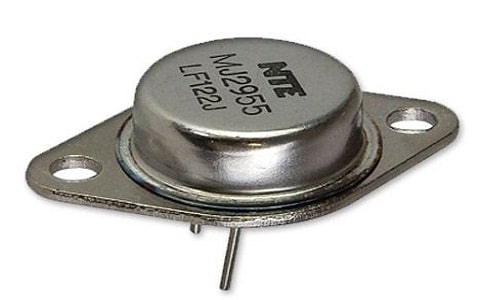
MJ2955 Transistor
While looking for a suitable transistor for your application based on a few factors, it is very important to look into a few points on How to Select a Transistor.
Working
MJE2955T is a PNP-type transistor thus the emitter and collector terminals will be forward-biased or closed whenever the base terminal is held at the GND, Similarly, when the transistor’s base terminal is connected to the GND, it will be reverse-biased or opened.
The MJ2955 transistor works, whenever a voltage supply or current supply is provided to one pair of the NPN transistor terminals, it controls the flow of current throughout the remaining terminals because the output power can be higher as compared to the input power.
MJ2955 Transistor Pin Configuration:
MJ2955 transistor pin configuration is shown below. This transistor includes three main terminals like a BJT which are discussed below.
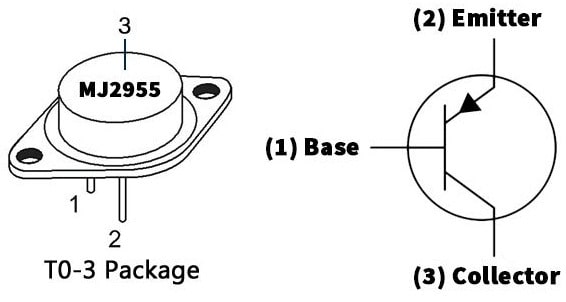
MJ2955 Transistor Pin Configuration
- Pin-1 (Base): It is used to control the transistor biasing.
- Pin-2 (Collector): It is a positive terminal of the transistor which collects the emitted electrons from the emitter.
- Pin-3 (Emitter): It is a negative terminal of the transistor that emits the electrons into the primary PN junction.
Features & Specifications:
The features and specifications of the MJ2955 transistor include the following.
- It is a PNP Bi-Polar power transistor.
- It is available in the TO-220 Package.
- Availability of Pb−free packages.
- It uses very superior process technology.
- This transistor has an outstanding secure operating region.
- It has less error voltage and a very fast switching speed.
- Full-voltage-based operation.
- It is capable of high power & current handling.
- Maximum DC gain or hFE is 100.
- Its continuous collector current or IC is 10Amps.
- The emitter to base voltage or VBE is 5 volts.
- Maximum base current or IB is 6Amps.
- Max collector-base voltage or Vcb is 60 V
- Its collector dissipation is 75 Watts.
- The transition frequency is 2 MHz.
- The noise figure ranges from 2 to 10 dB.
- Its collector capacitance is 8.5 pF.
- The maximum collector-to-emitter voltage is -60 V.
- The Max collector to base voltage is -100 V.
- Its emitter to base voltage maximum is -7 V.
- Its continuous collector current max is -15 A.
- Operating & Storage Junction Temperature Ranges from -65 to +200 °C
Equivalent & Complementary Transistors
Equivalent and Replacement MJ2955 transistors are; 2N5880, 2N5879, 2N5883, 2N5883G, 2N5884G, 2N5884, 2N6030, 2N6247, 2N6246, 2N6248, 2N6437, 2N6436, 2N6438, MJ14001G, MJ14001, MJ14003, MJ15016, MJ14003G, MJ2955A, MJ15016G, NTE219 or MJ2955G. The complementary MJ2955 transistor is the 2N3055.
Replacing a suitable transistor in any circuit based on requirement is very important. To know how to replace it, please refer to this; Replacing Transistors in Electronic Circuits: Factors and Considerations.
How to use MJ2955 Transistor securely in a Circuit?
To use the MJ2955 transistor very securely in a circuit, it is suggested not to use this transistor to its complete maximum ratings and to stay 20% under these ratings always. Its pinout has to be checked before connecting it to the circuit. So based on the 20% below usage guideline, if the maximum collector current is -100mA then we have to use -80mA only. The highest storage temperature is from -65 to +200 °C, thus we have to use this transistor in between these temperature limits.
100Watts Bass Amplifier Circuit
A bass amplifier is a significant circuit for music enthusiasts or musicians who want to improve their bass sound. The 100Watts bass amplifier circuit with MJ2955 and 2N3055 transistors is shown below. This bass amplifier circuit not only provides outstanding power but also provides clear sound through very deep bass tones or very impressive performance for mainly all your bass-playing requirements.
The required components to make this bass amplifier circuit mainly include; Transistors like; 2N3055, MJ2955, BD139, BD140, BC546, BC556, and BC560C, Resistors like; 18K, 3.9K, 1K, 2.2K, 15K, 22K, 330R, 10R, 47R 5W, and 10R 2W. Capacitors like; 1µF, 470pF, 47µF, 15pF, 220nF, 100nF, Miscellaneous like; ±35V power supply, 1N4148 diodes-4, and 4Ω speaker. Connect the circuit as per the diagram shown below.
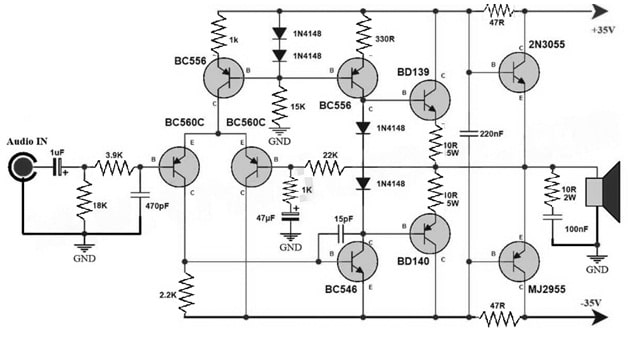
100Watts Bass Amplifier Circuit
Working
This high-quality and powerful 100Watts bass amplifier circuit with 2N3055 and MJ2955 transistors will greatly enhance your bass sound. In the output section, these transistors’ combination ensures sufficient power handling by allowing you to turn on the volume exclusive of sacrificing quality. In the driver section, it uses BD140, BD139, BC556, and BC546, transistors which deliver the required amplification as well as main control for best sound reproduction. Finally, in the preamplifier section, the BC560 transistor enhances the bass tone by providing a well-formed and clear sound.
Connecting a base resistor to the base terminal of the transistor is mandatory to avoid it being damaged. Please refer to this link for; Choosing Base Resistance for Transistors in Electronic Circuits.
MJ2955 Transistor Applications
The applications of the MJ2955 transistor include the following.
- Designers use the MJ2955 transistor for designing power switching circuits, high-fidelity amplifiers, and series & shunt regulators.
- People use it for general-purpose amplifiers and switching applications.
- These transistors are suitable for power linear, switching, and audio applications. Users apply it in signal processing, audio, and industrial areas.
- They carry 15 Amps of an impressive collector current which makes them to use in high power switching applications like motor drivers in power inverters.
- It is a versatile transistor, so used in high-power applications wherever high power loads the controlling is necessary.
- Its limited frequency range makes it a popular choice for use in amplifiers, though it can also be set up as a preamplifier in certain cases, primarily for a power amplifier stage.
- Users incorporate this transistor into regulator, PWM, and amplifier circuits. Manufacturers include it in signal amplifiers and SMPS.
Please refer to this link for the MJ2955 Transistor Datasheet.
Thus, this is an overview of the MJ2955 transistor, pinout, specifications, and its applications. MJ2955 PNP polarity transistor is a high-power transistor with 115W power dissipation and is housed within a TO-3 package. This transistor is generally used for general-purpose amplifiers and switching applications. Here is a question for you, what is an MJE340 transistor?