Darlington transistor was invented by an electrical engineer namely Sidney Darlington from the United States of America. Darlington transistor configuration mainly includes either two NPN or PNP transistors. This configuration provides current amplification and offers high gain, thus used for switching and amplification circuits. In this configuration, the signal is amplified by the first transistor after that it is amplified by the second transistor and provides a high-gain output signal. This Transistor’s operation is the same as a normal transistor. This article provides brief information on the BC516 darling transistor, pinout, specifications, and its applications.
What is BC516 Darlington Transistor?
BC516 is a PNP Darlington transistor designed in the TO-92 package, used as a general-purpose transistor to switch or amplify electronic signals & electrical power. So, it is applicable where a high gain of up to 30,000 is required. Generally, a Darlington transistor includes two transistors which are connected in a special mode to perform like a single transistor.
This transistor’s internal circuitry is not the same as compared to normal BJT although its usage procedure will be the same. The first transistor’s emitter terminal is the input that is connected to the base terminal of the second transistor. Finally, the collector terminals of two transistors are connected by a wire to one another.
Generally, this transistor’s base terminal is to the input signal through an appropriate current limiting resistor, the collector terminal is connected to the positive supply throughout the load, and the emitter terminal is connected to the negative supply.
This transistor’s maximum collector current is -1.2Amps, thus it cannot drive any load > 1.2Amps. The maximum collector-to-emitter voltage is -30Volts which means you cannot drive any load > -30V. The collector to base voltage maximum is -40V which is useful in controlling its operation. The maximum emitter to base voltage is -10V which shows the highest limit of the EB junction for reverse voltage and > -10V can collapse the transistor. This transistor’s maximum collector dissipation is 625mWatts which shows the highest heat BC516 transistor can handle with no harm.
While looking for a suitable transistor for your application based on a few factors, it is very important to look into a few points on How to Select a Transistor.
Pin Configuration:
The pin configuration of the BC516 transistor is shown below. This transistor includes three terminals which are discussed below.
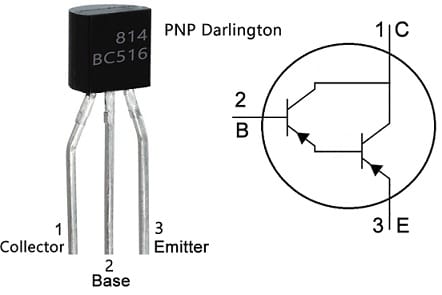
BC516 Darling Transistor Pin Configuration
Pin-1 (Collector): It is a positive terminal of the transistor which collects emitted charge carriers from the emitter terminal. This terminal is doped moderately, and its region size is somewhat above the emitter region due to charge carriers from the emitter terminal being recombined at the base. This heat will be generated in this procedure. So, it is required to be large in this terminal to dissipate the generated heat.
Pin-2 (Base): This terminal is used to bias the transistor by turning ON and OFF the transistor. The base size is very small compared to the emitter & the collector terminals. So that charge carriers from the emitter enter into the base terminal will not recombine and it will be directed to the collector region. Base terminal doping intensity can also be below to emitter & collector.
Pin-3 (Emitter): It is a negative terminal of the transistor that emits the charge carriers. It is a heavily doped region when compared with the remaining two transistor terminals because the emitter terminal supplies charge carriers through the base to the collector. The emitter size is more as compared to the base terminal but below the collector.
Features & Specifications:
The features and specifications of the BC516 transistor include the following.
- BC516 is an NPN Darlington-type transistor.
- It is available in the TO-92 Package.
- Its maximum collector current or IC is -1.2Amps.
- Collector to emitter voltage or VCE is -30Volts.
- Collector to base voltage or VCB is -40Volts.
- Maximum emitter to base voltage or VEBO is -10Volts.
- Collector dissipation or PC is 625 mW.
- The maximum transition frequency or fT is 200 MHz.
- DC gain or hFE is 30000.
- Its maximum storage & operating temperature is from -55 to +150 Centigrade.
Equivalent & Complementary Transistors
Equivalent BC516 transistors are; BC517, MPSA14, KSP64, MPSA64, etc. The complementary BC516 transistor is the NPN BC517 transistor.
Replacing a suitable transistor in any circuit based on requirement is very important. To know how to replace it, please refer to this; Replacing Transistors in Electronic Circuits: Factors and Considerations.
How to use BC516 Transistor in a Circuit Securely for Long Term?
To operate this transistor very securely in a circuit it is recommended not to utilize it to its absolute max ratings & use 20% below its ratings. Thus, the maximum CE voltage is about -30V thus do not drive any load > 24Volts. The maximum collector current is about 1.2Amps thus you should not drive any load > 0.96Amps. The emitter-base voltage should be below -10V and store (or) operate it always at > -55 and < +150 degrees temperatures.
RF Detector Circuit with BC516 Darling Transistor
RF detector circuit (RF receiver circuit) is an electronic device, used to detect radio frequency signals, various radio gadgets frequencies, and electromagnetic and electrical waves. The required components to make this RD detector circuit mainly include; a 9V to 12V battery, 1N34 Germanium Diodes, BC5161 Darlington transistors, 2N4401 NPN transistors, 30 inches antenna, 10kΩ and 2.2kΩ resistors and Buzzer.
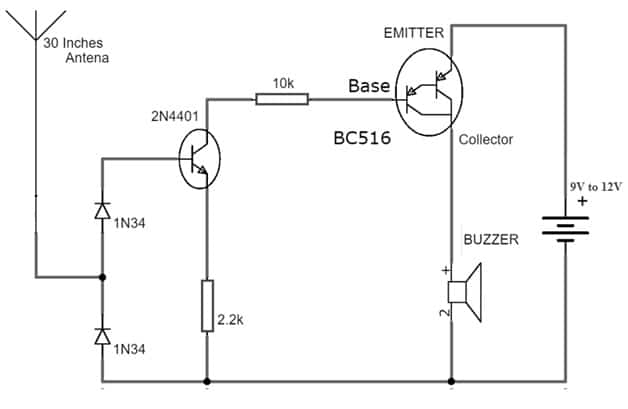
RF Detector Circuit with BC516 Darling Transistor
Working
This circuit is powered by any 9V or 12V battery supply. This circuit uses two 1N34 Ge diodes which can be displaced by some other relative germanium diodes. Therefore, use a 30-inch telescope antenna or receiving wire for excellent execution.
RF detector is used to change the signal from sinusoidal RF to a DC voltage for estimating the signal’s power level. This circuit works as; whenever the two germanium diodes obtain a radio frequency signal they change it into a DC signal. Further, this signal can be amplified with the 2N4401 NPN transistor & transmitted into the base terminal of the PNP BC516 Darlington transistor. Therefore, it can be done by switching ON and performing the bell. Here, for good execution, a 30-inch telescope antenna is used.
Connecting a base resistor to the base terminal of the transistor is mandatory to avoid it being damaged. So, Please refer to this link for; Choosing Base Resistance for Transistors in Electronic Circuits.
Light Sensitive Automatic Lamp Using BC516
Objective
This project uses an LDR and BC516 transistor to automatically switch ON an LED in darkness.
Components Required
- 1 × BC516 Transistor
- 1 × LDR
- 1 × 10kΩ Resistor
- 1 × LED
- 1 k Resistor
- 5V Battery
Circuit Diagram
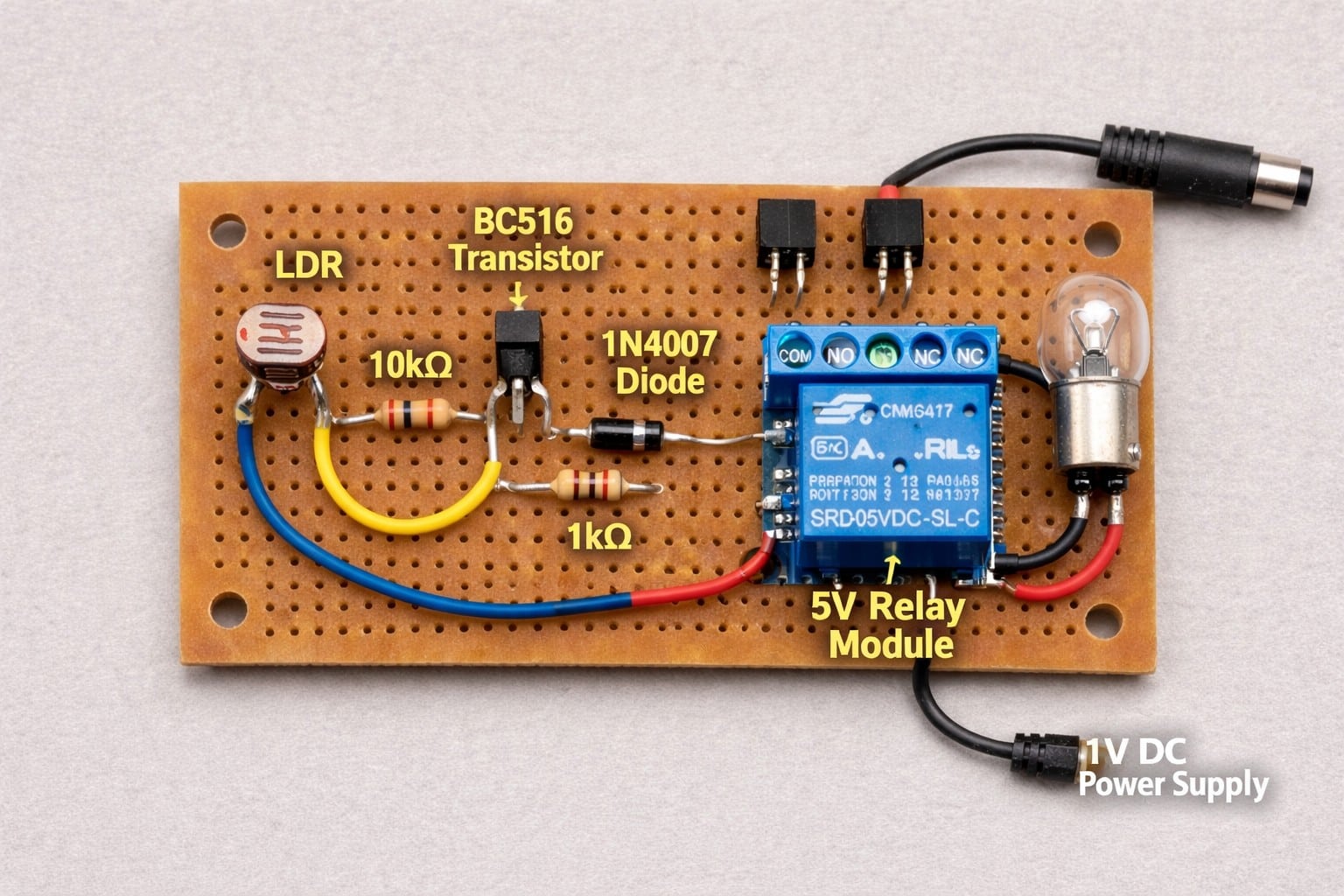
Working Principle:
- During daylight:
- LDR resistance becomes low.
- Base voltage becomes insufficient.
- BC516 remains OFF.
- LED remains OFF.
- During darkness:
- LDR resistance increases.
- Base voltage rises.
- BC516 turns ON.
- LED glows automatically.
Why BC516 is Special in These Projects
The BC516 is very useful because:
| Feature | Benefit |
| Very High Gain | Can detect very weak signals |
| Darlington Pair | Better sensitivity |
| Low Base Current | Saves power |
| Easy Switching | Suitable for automation projects |
| Compact Size | Ideal for breadboard experiments |
Safety Notes
- Do not exceed 30V across Collector-Emitter terminals.
- Always use a resistor with LEDs.
- Use a protection diode with relay loads.
- Check transistor pin connections carefully before powering the circuit.
These BC516 transistor projects help beginners understand:
- How transistors amplify current
- How switching circuits work
- Relay driving principles
- Sensor interfacing
- Automatic control systems
The LED touch switch project is especially useful for students because it practically demonstrates how a very tiny current can control a larger electrical load using transistor amplification.
Advantages & Disadvantages
The advantages of the BC516 transistor include the following.
- BC516 transistor provides extremely high current gain as compared to a single BJT.
- This transistor provides high input impedance.
- Circuit design is simple by using this transistor.
- This transistor amplifies the signal to a larger level.
- It is very responsive to the current.
- Darlington pair transistor provides low response time.
- It generates less heat because it utilizes a cross-section configuration.
- It allows driving more power applications with few mA of current source.
- This transistor generates less noise.
The disadvantages of the BC516 transistor include the following.
- When this transistor is in saturation region then the voltage drop will be there across base and emitter terminals.
- Its switching speed is low.
- Its Bandwidth is limited.
- Darlington pair transistor configuration establishes phase shifts at particular frequencies within a negative feedback circuit.
- This transistor provides high power dissipation because of the high saturation voltage.
- In the Darlington transistor, the leakage current of the primary transistor can be changed with the secondary transistor. Thus, the overall leakage current will be higher.
Applications
The applications of BC516 transistors include the following.
- BC516 transistor is used within any circuit that needs changing of a signal from a low-gain to a high-gain (or) driving any load from a low-level signal.
- It is used in signal amplification circuits wherever we need to enhance the signal to an excellent level.
- This transistor is used to amplify the sensor output thus we can improve the sensor sensitivity.
- This transistor is used in sensor circuits, audio preamplifiers, motor drivers, voltage regulators, audio amplifiers, battery chargers, control systems, etc.
Please refer to this link for the BC516 Darling Transistor Datasheet.
Thus, this is an overview of the BC516 darling transistor, pinout, features, specifications, circuit, working advantages, disadvantages, and applications. This is mainly designed to be used in applications where extremely high current gain at 1mA currents is required. Here is a question for you, what is BC517 transistor?