Modern electronic devices such as smartphones, tablets, smart TVs, IoT devices, autonomous vehicles, and AI-powered systems require extremely high computing performance while maintaining low power consumption and compact size. To achieve this, semiconductor manufacturers integrate multiple functional units of a computer system onto a single integrated circuit, which is known as a System on Chip (SoC).
A System on Chip (SoC) is a highly integrated semiconductor device that combines essential components such as processors, memory controllers, communication interfaces, hardware accelerators, and peripheral modules onto a single chip. Instead of using multiple chips, such as a CPU, GPU, RAM controller, and I/O controllers, on a motherboard, an SoC integrates all these components into a single silicon die.
This integration significantly reduces power consumption, system size, manufacturing cost, and signal latency, while improving overall system performance and reliability. As a result, SoCs are widely used in smartphones, embedded systems, automotive electronics, wearable devices, networking equipment, and artificial intelligence hardware.
Modern SoCs often include multiple processing elements, such as CPU cores, graphics processors (GPUs), digital signal processors (DSPs), neural processing units (NPUs), memory subsystems, and communication interfaces, all interconnected through high-speed on-chip networks. This article provides a detailed explanation of SoC architecture, its main components, working principle, and real-world applications.
What is SoC Architecture?
SoC architecture refers to the internal structural design of a System on Chip, which defines how different hardware components, such as processors, memory units, communication interfaces, and peripheral controllers, are integrated and interconnected on a single silicon chip. The architecture determines how data flows between various subsystems and how efficiently the chip performs computation, communication, and control tasks.
Typical SoC architecture integrates:
- Central Processing Unit (CPU)
- Graphics Processing Unit (GPU)
- Memory subsystems
- Hardware accelerators
- Communication interfaces
- Peripheral controllers
- Power management modules
- On-chip interconnect networks
All these modules work together to perform the functions of a complete computing system within a single integrated circuit.
Block Diagram of System on Chip Architecture
Below is a simplified conceptual representation of a System on Chip architecture.
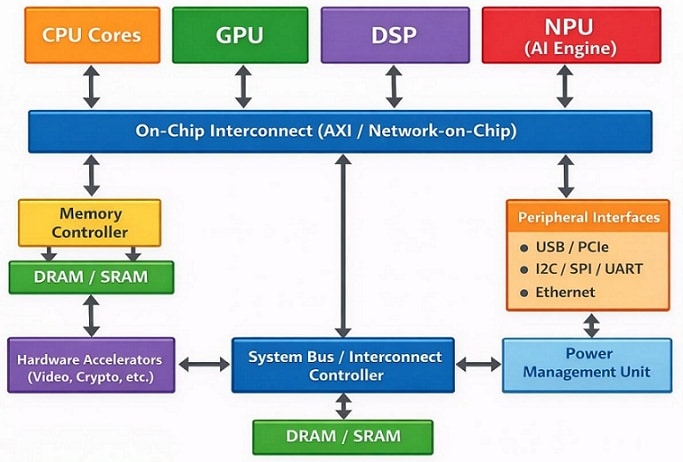
System on Chip Architecture
This diagram shows the integration of multiple processing units, memory systems, and communication interfaces within a single chip.
Major Components of System on Chip Architecture
1. Central Processing Unit (CPU)
The CPU is the primary processing unit of the SoC responsible for executing program instructions and performing general-purpose computations.
Modern SoCs often contain multi-core CPUs, which allow multiple tasks to be executed simultaneously. CPU cores may follow architectures such as:
- ARM Cortex series
- RISC-V processors
- x86 architecture (rare in mobile SoCs)
- The CPU performs operations like:
- Arithmetic calculations
- Logical operations
- Program control
- Data processing
2. Graphics Processing Unit (GPU)
The GPU is a specialized processor designed to perform parallel computations required for graphics rendering and image processing.
GPUs accelerate operations such as:
- 3D rendering
- Video processing
- image filtering
- gaming graphics
In modern systems, GPUs also support AI and machine learning workloads through parallel computation.
3. Digital Signal Processor (DSP)
A DSP is designed for high-speed signal processing applications. It efficiently handles repetitive mathematical operations such as multiplication and accumulation.
DSPs are used in applications such as:
- audio processing
- speech recognition
- video encoding
- wireless communication
- radar systems
4. Neural Processing Unit (NPU)
The NPU is a dedicated hardware accelerator designed to perform artificial intelligence computations.
NPUs are optimized for tasks like:
- neural network inference
- image recognition
- object detection
- natural language processing
Modern smartphone SoCs include NPUs to accelerate AI-based applications such as facial recognition and voice assistants.
5. Memory Subsystem
Memory plays a critical role in SoC performance. The memory hierarchy typically includes:
Registers
Small and extremely fast storage inside the CPU.
Cache Memory
Fast SRAM memory is used to store frequently accessed data.
Levels include:
- L1 Cache
- L2 Cache
- L3 Cache
Main Memory
External memory, such as DRAM used for storing programs and data.
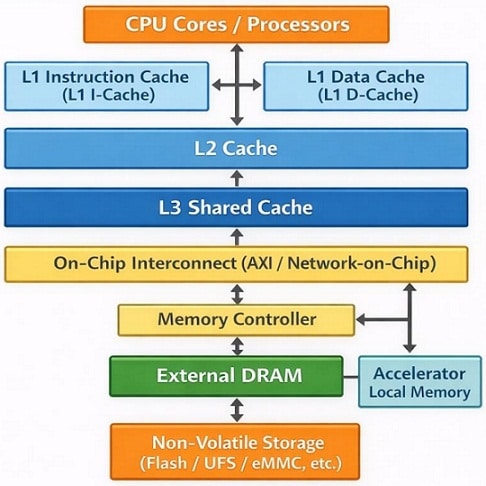
Memory Hierarchy of SoC
6. On-Chip Interconnect
The on-chip interconnect is responsible for communication between different components within the SoC.
Common interconnect architectures include:
AMBA Bus Architecture
Developed by ARM.
Includes:
- AXI (Advanced eXtensible Interface)
- AHB (Advanced High-performance Bus)
- APB (Advanced Peripheral Bus)
Network-on-Chip (NoC)
Used in large SoCs to connect multiple processing units using packet-based communication.
7. Peripheral Interfaces
Peripheral controllers allow the SoC to communicate with external devices.
Common interfaces include:
These interfaces enable communication with sensors, storage devices, displays, and networking systems.
8. Power Management Unit (PMU)
Power management is extremely important in SoC design, especially for battery-powered devices.
The PMU controls voltage and power distribution within the chip.
Power optimization techniques include:
- Dynamic Voltage and Frequency Scaling (DVFS)
- Clock gating
- Power gating
- Multi-voltage domains
These techniques help reduce energy consumption while maintaining performance.
9. Hardware Accelerators
Hardware accelerators are specialized units designed to perform specific computational tasks much faster than general-purpose CPUs.
Examples include accelerators for:
- video encoding
- cryptography
- machine learning
- image processing
By offloading complex tasks to dedicated hardware, the SoC can significantly improve efficiency.
Working of a System on Chip
The operation of an SoC involves coordinated interaction between multiple subsystems.
- The CPU fetches instructions from memory.
- Instructions are decoded and executed by the processor.
- If specialized processing is required, tasks may be delegated to units like GPU, DSP, or NPU.
- Data transfers occur through the on-chip interconnect network.
- The memory controller manages data exchange between processors and external memory.
- Peripheral controllers handle communication with external devices.
- The power management unit dynamically adjusts voltage and clock frequency to maintain energy efficiency.
Through this coordinated operation, the SoC functions as a complete computing system on a single chip.
Advantages of System on Chip Architecture
Major advantages of SoC architecture include:
Reduced Power Consumption
Integration reduces power loss caused by external interconnections.
Compact System Size
Multiple components are integrated into a single chip.
Improved Performance
Shorter signal paths improve data transfer speed.
Lower Manufacturing Cost
Fewer chips reduce production cost.
Higher Reliability
Reducing external wiring decreases system failure points.
Applications of System on Chip Architecture
SoCs are used in a wide range of electronic systems.
Smartphones
Mobile processors such as Snapdragon and Apple Silicon.
Internet of Things (IoT)
Smart sensors, home automation systems, and wearable devices.
Automotive Electronics
Advanced driver assistance systems (ADAS) and infotainment.
Artificial Intelligence Systems
Edge AI processors are used for machine learning inference.
Networking Equipment
Routers, switches, and 5G base stations.
Consumer Electronics
Smart TVs, gaming consoles, and digital cameras.
Future Trends in SoC Architecture
The future of SoC design is moving toward more advanced integration technologies.
Major trends include:
AI-Centric SoCs
Chips designed specifically for machine learning workloads.
Chiplet-Based Architectures
Multiple small dies are combined within a single package.
3D Integrated Circuits
Stacking of multiple silicon layers.
Edge AI Processors
Low-power AI chips for edge computing devices.
Advanced Semiconductor Nodes
Manufacturing technologies such as 3 nm and 2 nm processes.
These innovations will continue to improve computing performance while maintaining energy efficiency.
FAQ’s
1. What is a System on Chip (SoC)?
A System on Chip (SoC) is an integrated circuit that combines multiple components of a computing system, such as CPU, GPU, memory controllers, communication interfaces, and peripherals, onto a single silicon chip.
2. What are the main components of SoC architecture?
The major components of SoC architecture include:
- CPU (Central Processing Unit)
- GPU (Graphics Processing Unit)
- Memory subsystem (SRAM, DRAM)
- On-chip interconnect (AMBA / NoC)
- Peripheral interfaces (UART, SPI, I2C)
- Hardware accelerators
- Power management unit
3. What is the difference between SoC and a microcontroller?
A microcontroller is designed for embedded control systems and integrates CPU, memory, and peripherals for simple applications.
An SoC integrates advanced processing units like GPU, AI accelerators, and high-speed communication modules used in complex computing systems such as smartphones and AI devices.
4. Why are SoCs used in smartphones?
SoCs are used in smartphones because they provide:
- high computing performance
- low power consumption
- compact design
- efficient multimedia processing
- integrated wireless communication
Examples include Apple A-series processors and Qualcomm Snapdragon chips.
5. What is Network-on-Chip (NoC)?
Network-on-Chip (NoC) is an advanced communication architecture used in large SoCs where multiple processing cores communicate through packet-based networks rather than traditional buses.
6. What are hardware accelerators in SoC?
Hardware accelerators are specialized processing units designed to perform specific tasks such as:
- AI computation
- video encoding
- cryptographic operations
- image processing
They improve performance and reduce CPU workload.
Conclusion
System on Chip architecture represents one of the most important advancements in modern semiconductor technology. By integrating processors, memory subsystems, communication interfaces, and hardware accelerators into a single integrated circuit, SoCs enable the development of compact, energy-efficient, and high-performance electronic systems.
SoCs form the backbone of today’s computing devices, including smartphones, IoT systems, automotive electronics, and artificial intelligence hardware. Understanding SoC architecture helps engineers and students gain insight into how modern computing systems are designed and optimized for performance and power efficiency.
As semiconductor technology continues to evolve with innovations such as AI accelerators, chiplet architectures, and 3D integration, SoC architectures will play a crucial role in shaping the future of electronics and computing.